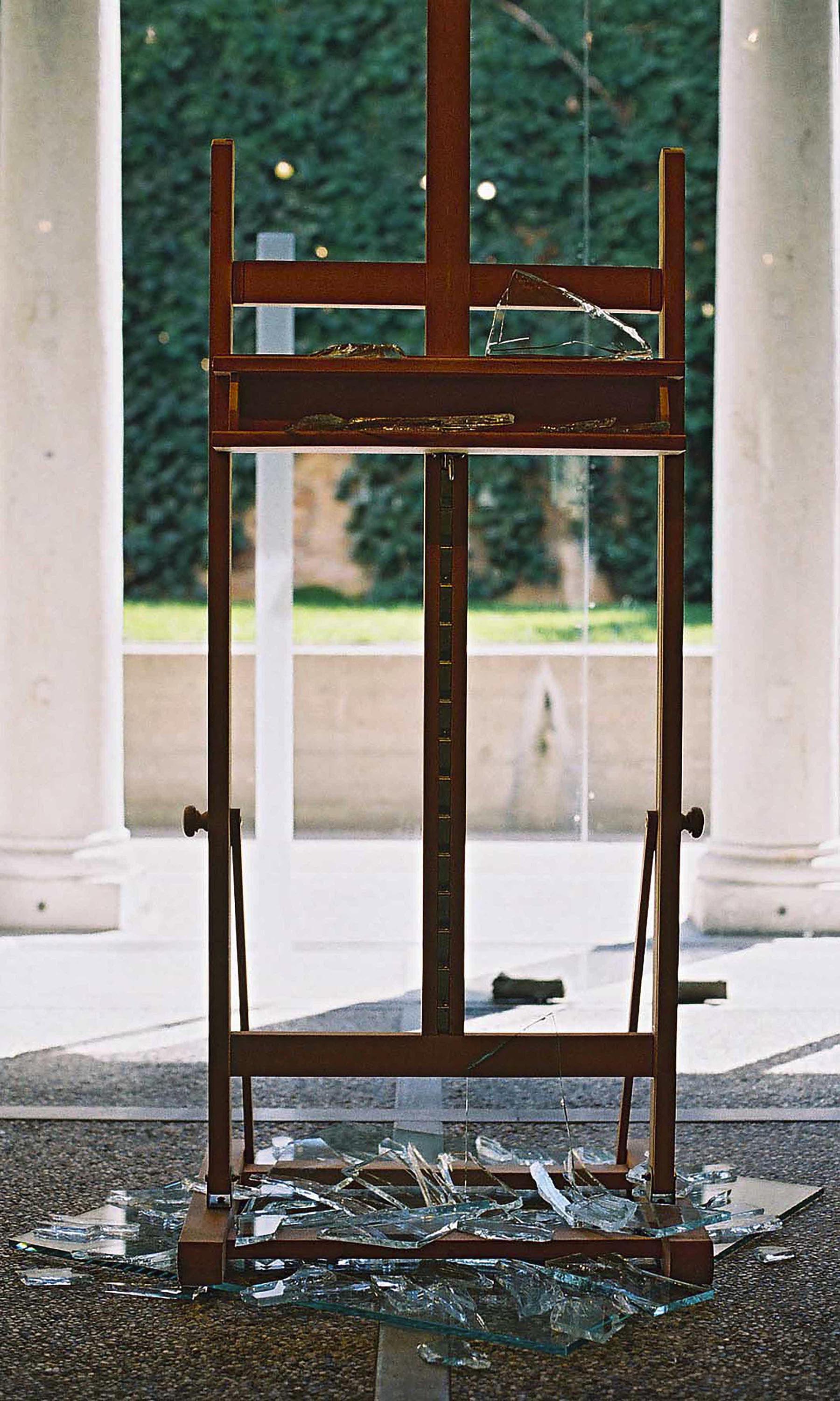
Omega (Il corpo dell’opera), 2004
GPO-0885
Omega (The Body of the Artwork)
Easels, glass sheets, unstretched primed canvas, crumpled photographic reproduction, fragments of photographic reproduction, glass fragments
Seven glass sheets 80 x 80 cm each, overall dimensions variable
Dismantled work
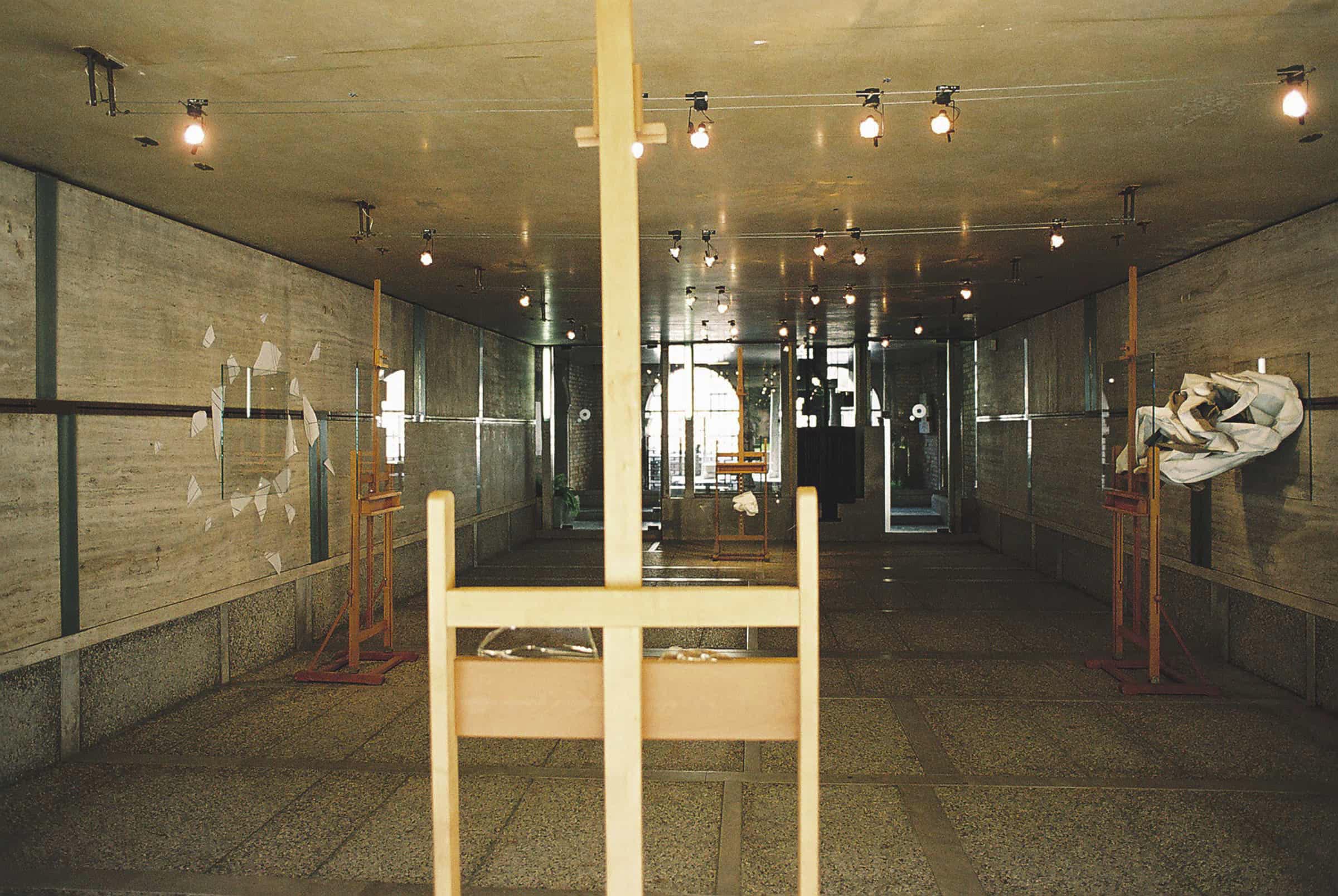
Four easels, each of which placed at the center of the four walls of the exhibition space, are each associated with two glass sheets and a different intervention:
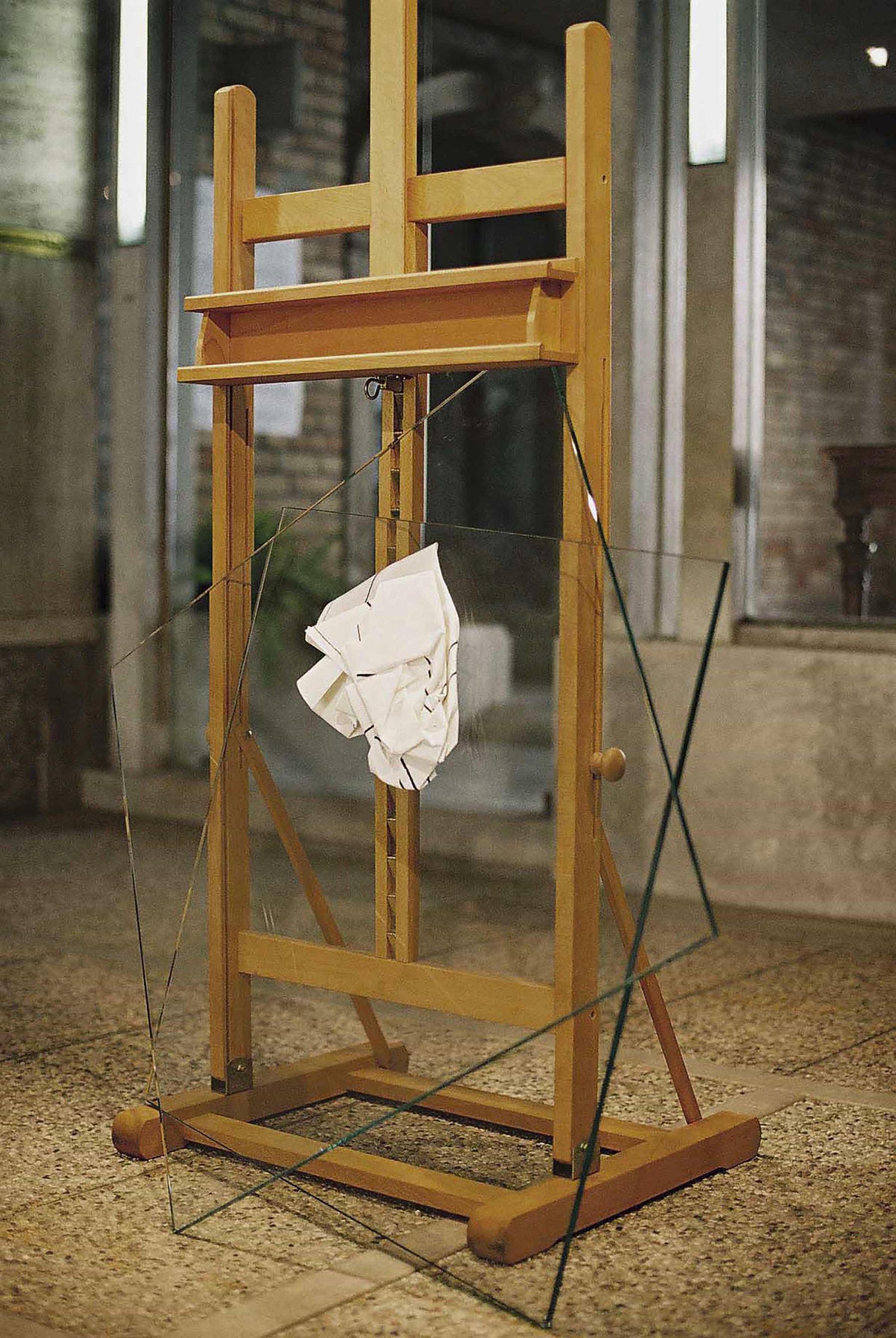
• in the first easel, set up next to the entrance, the two sheets are laid down on the ground, in precarious balance, each of them holding a crumpled drawing;1
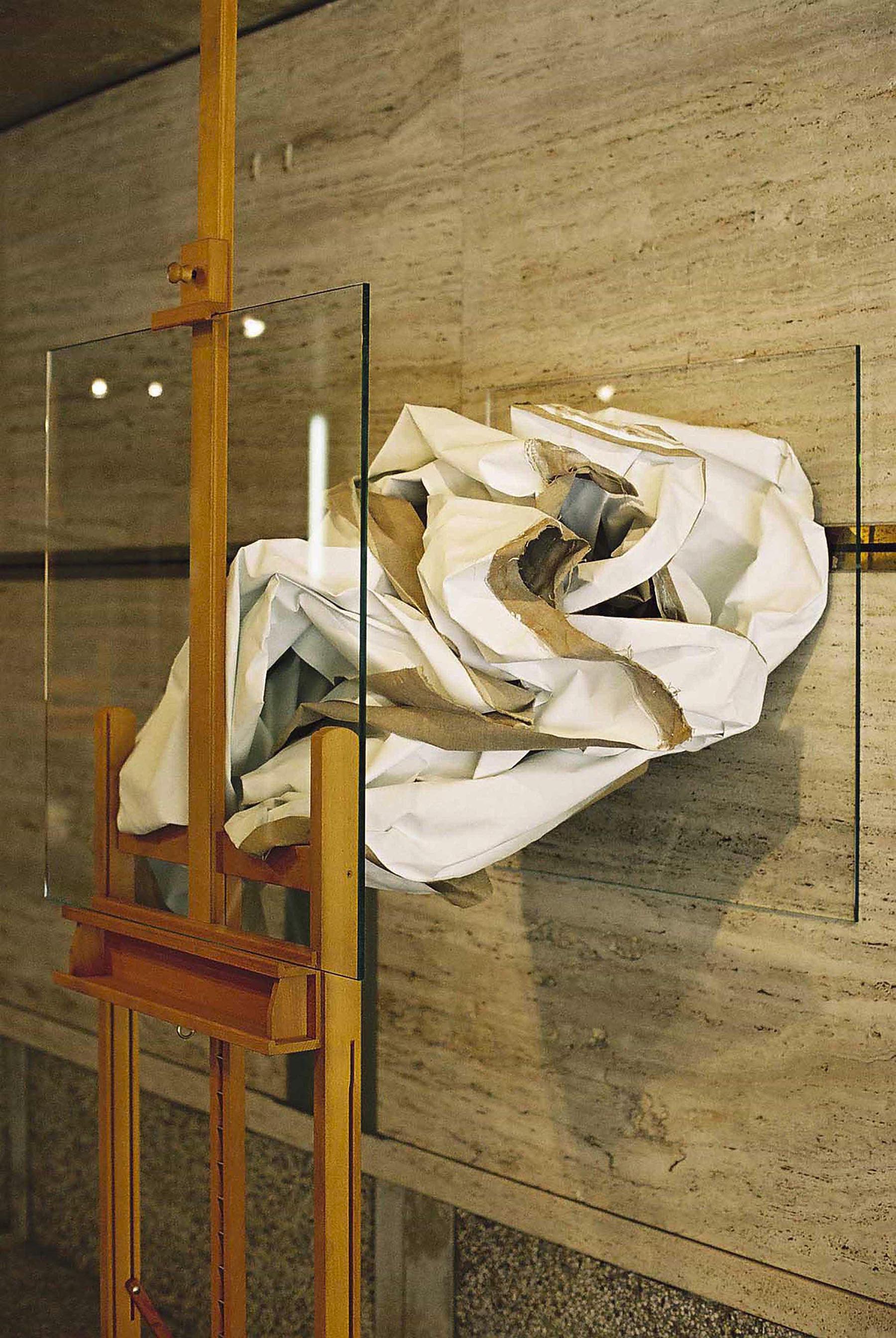
• in the second easel, continuing in a clockwise direction, one sheet is placed on the easel, as though it were a canvas, while the other is hanging on the wall behind it; between them is a crumpled unstretched canvas;
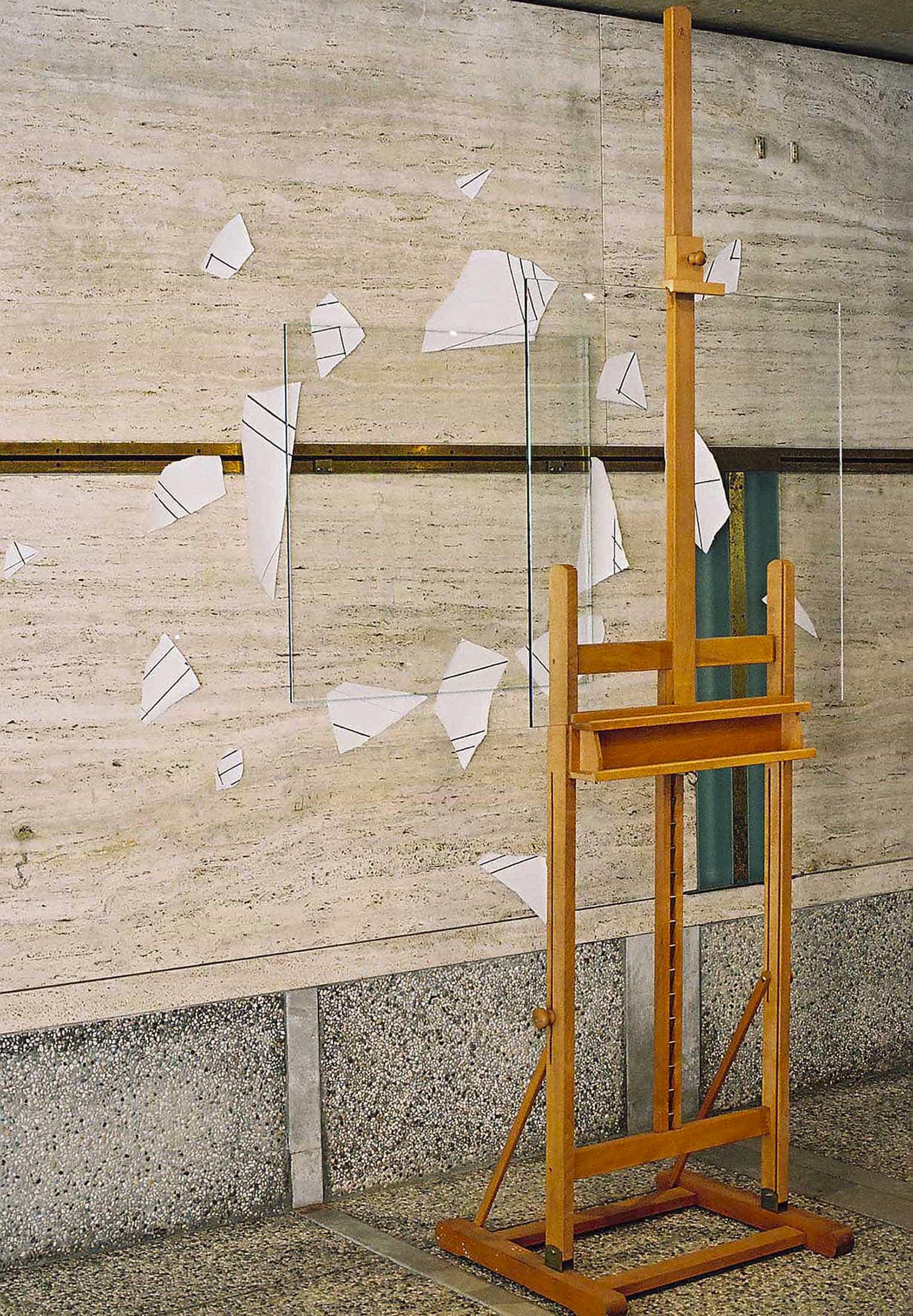
• in the third easel, a sheet is laid down on the ground, underneath the easel, while the other one is shattered, its pieces scattered across the whole sheet; some of the fragments are gathered on the support base of the easel;
• in the fourth easel, one sheet is placed on the easel, while the other is hanging on the wall; a multitude of torn fragments, scattered across the wall from the edges of the sheet outwards, and progressively fewer, disperses an exploded drawing in unrecognizable details.2
The common denominator of the four episodes is the explosion or, more appropriately, the implosion of the material making up a hypothetical painting. In all the cases, the image is absent, unrecognizable, or hidden: the “body of the work” – as the subtitle tells us – remains an anonymous entity, an unknown identity.
The title Omega is inscribed in the conceptual design of the solo exhibition presented at the Fondazione Querini Stampalia in Venice in 2004, for which the work was conceived. The exhibition comprising three works, entitled Alfa (L’autore senza nome) (GPO-0884), Capogiro (Lo sguardo dello spettatore) (GPO-0886), and Omega (Il corpo dell’opera), stated the three main “actors” of the “theatre” of Art: the Author (Alfa), the Work (Omega) – respectively, the first and last letters of the Greek alphabet, “origin or initial figure” and “final instant of the definition”3 – and the Viewer.
In 2009 the artist re-elaborated the theme for a new homonymous work (GPO-1110).
1 This is the reproduction of the drawing of a room seen in perspective used in 1983-85 for the series of works entitled Trionfo della rappresentazione (cf. GPO-0507).
2 The torn image represents the same drawing as the crumpled one in the previous easel.
3 G. Paolini, in Giulio Paolini. L'ora X, exhibition catalogue, Venice, Fondazione Querini Stampalia (Prato: Gli Ori, 2004), p. 27. The three exhibited works were arranged in three different exhibition spaces: Alfa and Capogiro on the piano nobile featuring period furniture, which hosts the permanent collections, and Omega on the ground floor near the Carlo Scarpa area.
| 2004 | Venice, Fondazione Querini Stampalia, Giulio Paolini. L'ora X, 28 March - 30 May, col. repr. pp. 46-50 (exhibition view), artist’s writing pp. 27-31, references in the text by C. Bertola, pp. 59-61. |
| • | G. Paolini in Giulio Paolini. L'ora X, exhibition catalogue, Venice, Fondazione Querini Stampalia (Prato: Gli Ori, 2004), pp. 27-31. |
| • | C. Bertola, “Giulio Paolini”, in Id., Conservare il futuro (Venice: Fondazione Querini Stampalia, 2023), pp. 53-54, 257, repr. p. 52 (exhibition view Venice 2004, detail), col. repr. p. 160 (exhibition view Venice 2004). |

