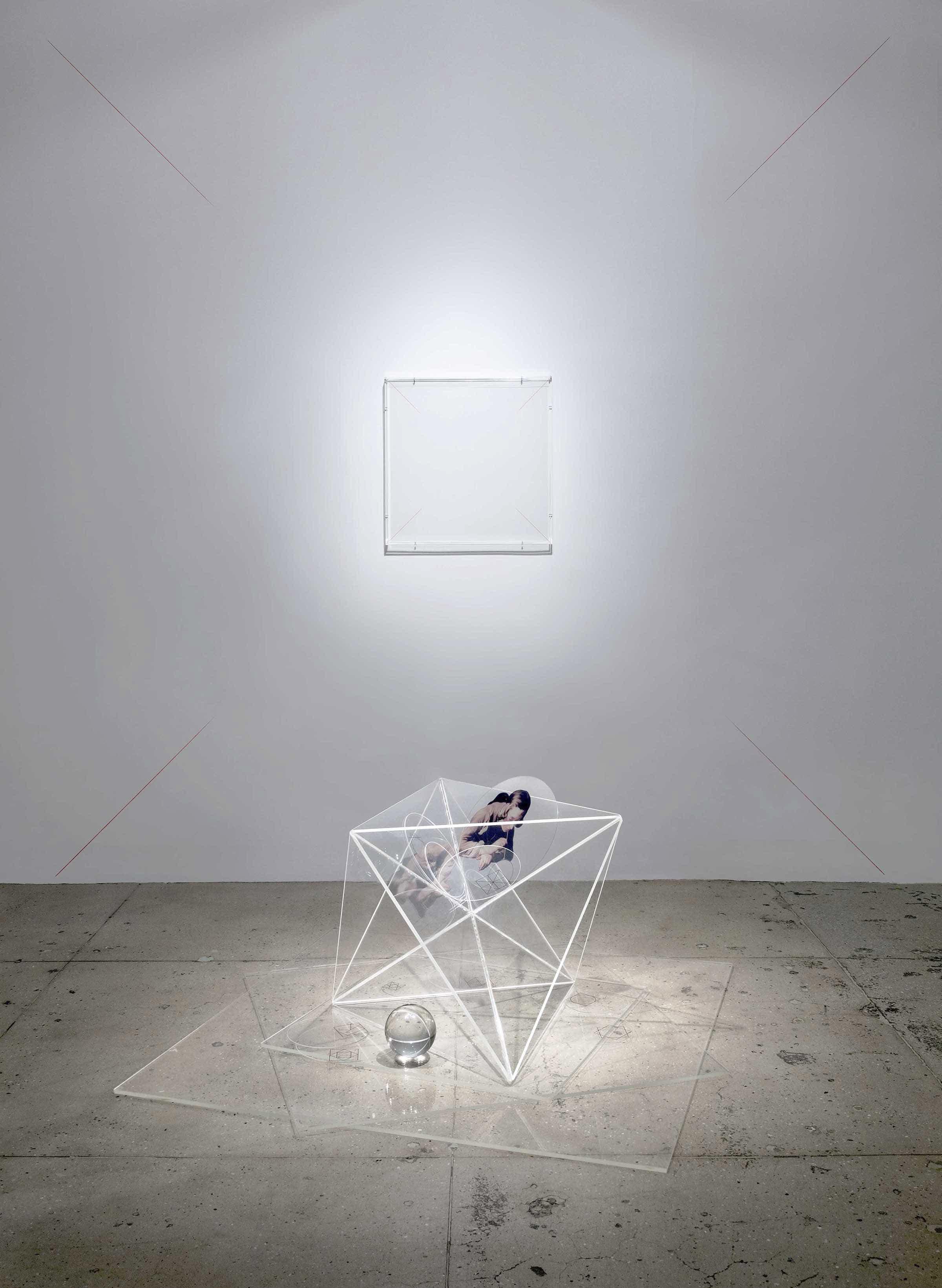
Alfa (Un autore senza nome), 2004
GPO-0884
Alpha (An Author without Name)
Plexiglas polyhedron and sheets, reproductions printed on plexiglas, crystal sphere
Polyhedron 70 x 80 x 80 cm, three plexiglas sheets: 150 x 150 cm, 120 x 120 cm, 90 x 90 cm, overall dimensions 75 x 210 x 210 cm
Collection of the artist
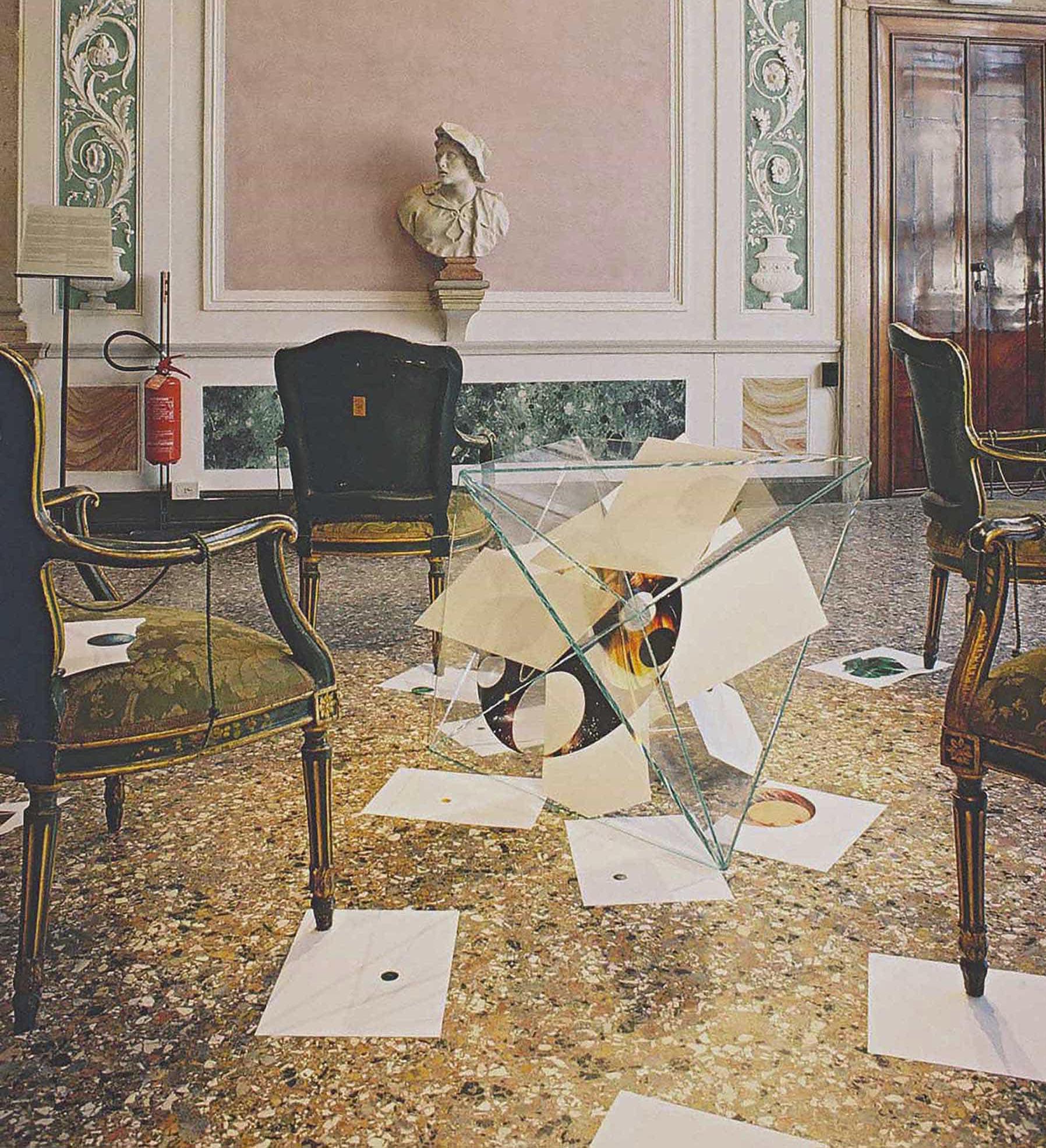
• 2004, Venice, Fondazione Querini Stampalia: the crystal polyhedron contains the colour reproduction of Chardin’s young man associated with a group of planets reproduced on acetate and divided into four parts, placed close together on adjacent sides of the volume, so that they recompose the image. The round shape “blown” by the young man is situated at the exact centre of the polyhedron. Moreover, some blank sheets are placed to the sides of the volume, with reproductions of planets or a circular cut out evoking in negative the shape of a planet. Scattered all around on the ground are other details of planets reproduced on acetate in different tones and arranged on torn blank sheets, as if they were “soap bubbles” that have exploded from the central nucleus. The polyhedron is located in the central area of the room, surrounded by four armchairs (borrowed from the furnishings of the room), turned in various ways to recall a “conversation scene”.
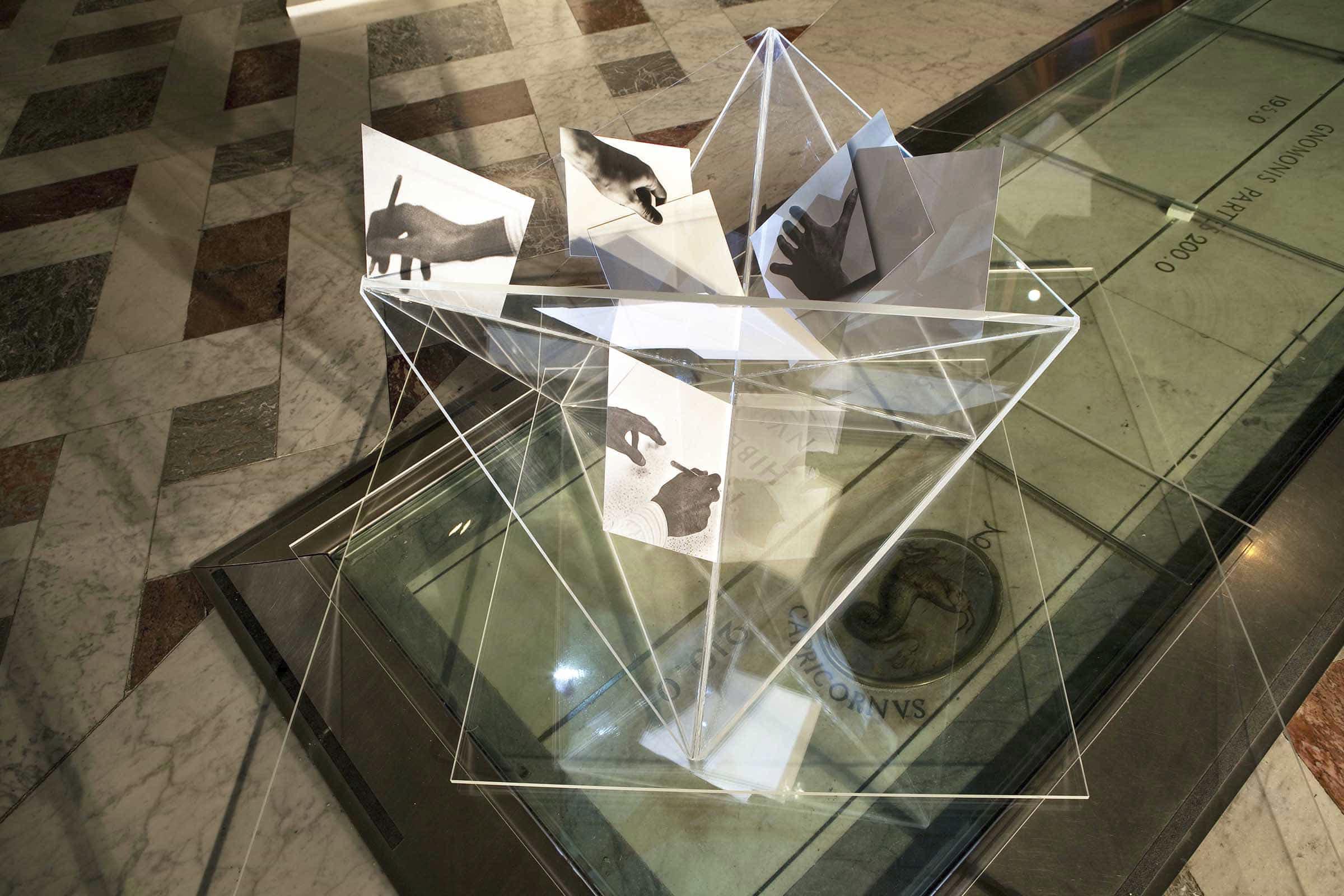
• 2009, Naples, Museo Archeologico: the polyhedron (this time in plexiglas to replace the original one that was too heavy to move) contains seven photographic reproductions of the artist’s hands while he is making Vedo (la decifrazione del mio campo visivo), 1969, or holding a blank sheet or a pencil (some of the photographs are arranged in twos), as if to literally bring to life his attempt to touch what is unknown. The volume is set down on three sheets of plexiglas of different formats and arranged so that they are staggered. For the exhibition the work was arranged at the centre of the room, corresponding to the extreme end of the Meridian set in the floor.
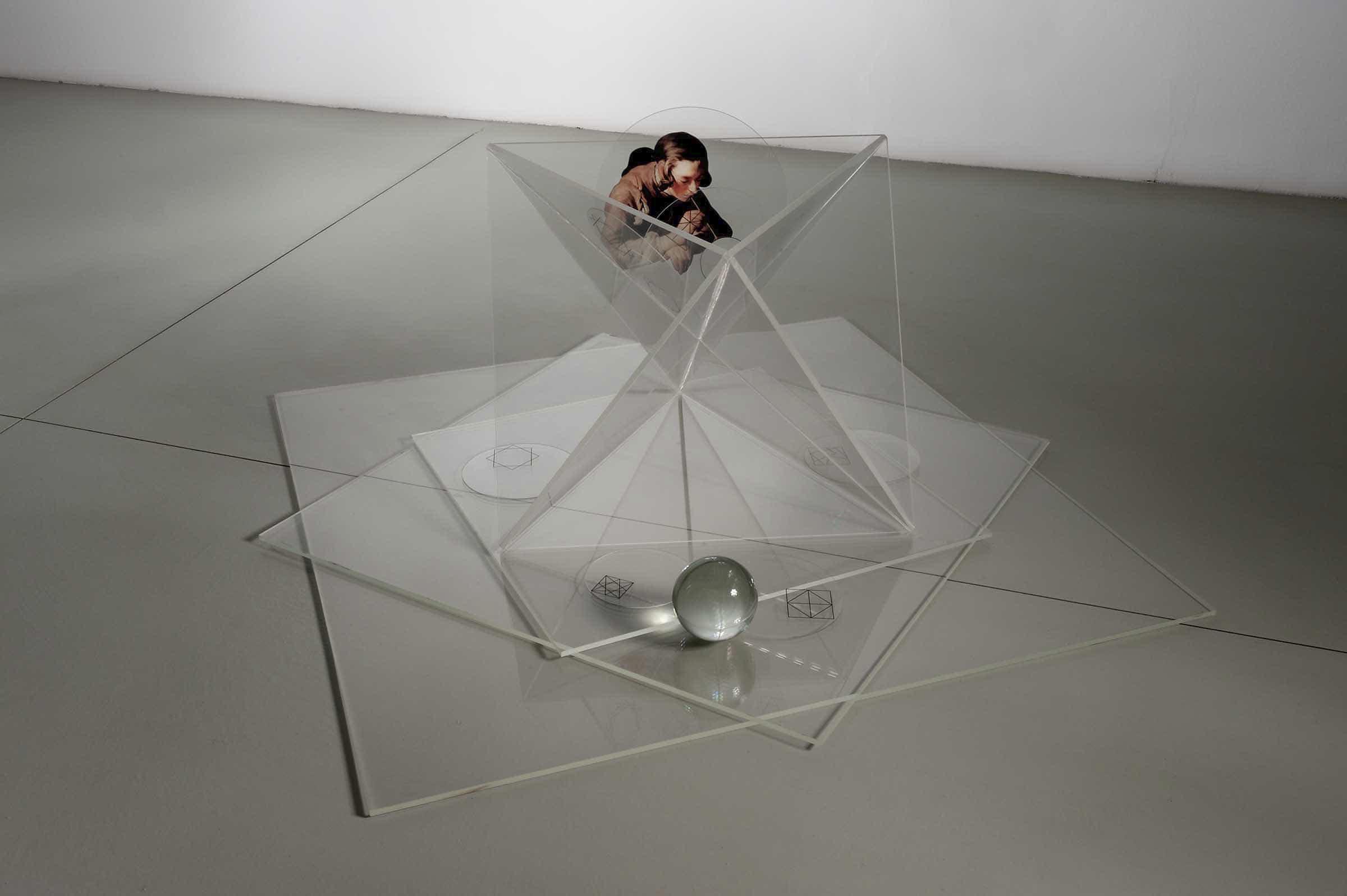
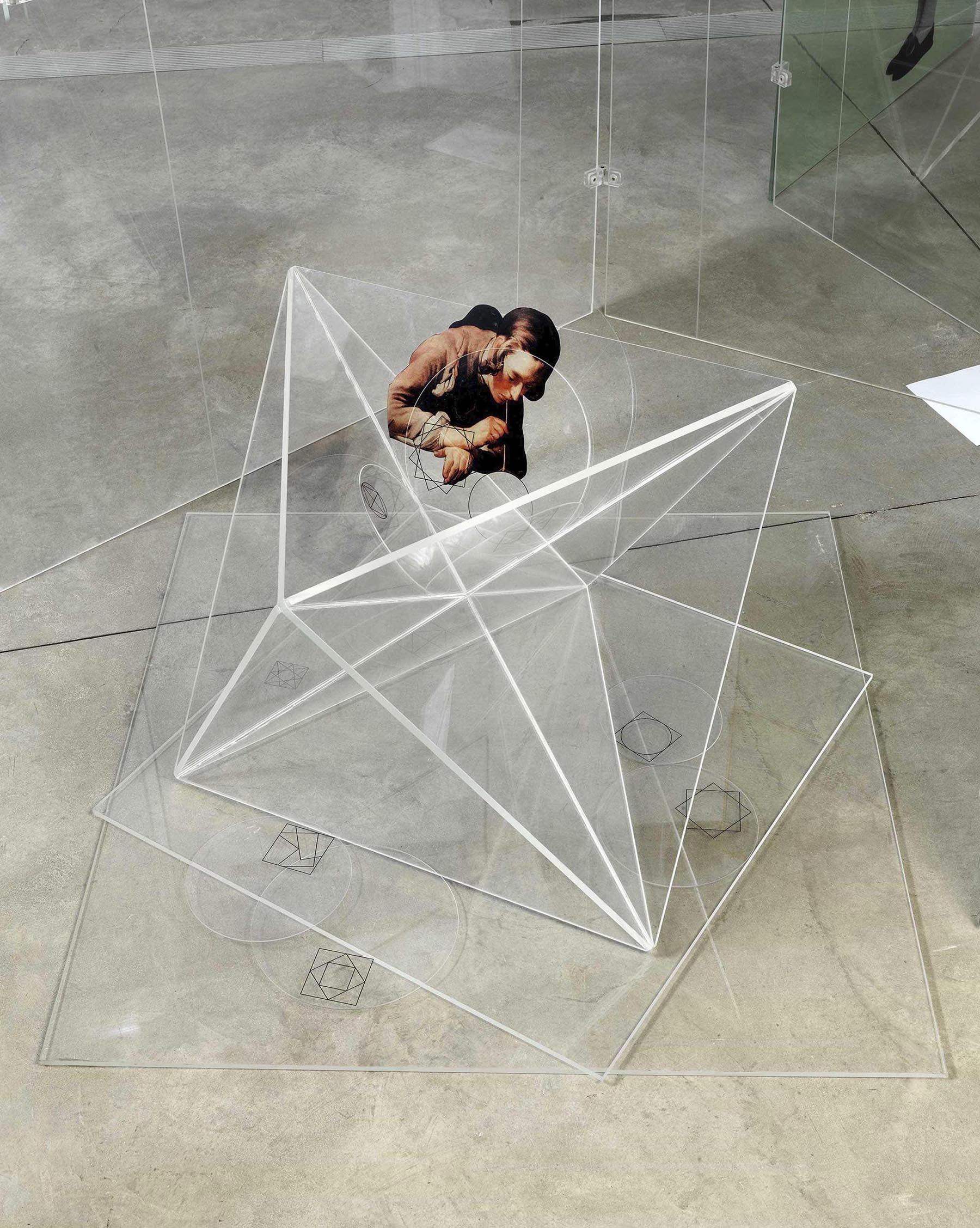
• 2013, Rome, MACRO and 2014, London, Whitechapel: the polyhedron, placed on two staggered sheets of plexiglas , contains the cut-out image of Chardin’s young man, reproduced on a plexiglas round, and nine linear drawings of squares and circle, they too reproduced on plexiglas rounds (three of them are next to the young man, the others are farther down on a plexiglas sheet).
• 2015, New York, Marian Goodman Gallery: the polyhedron, set down on three staggered plexiglas sheets, contains the same elements as in Rome and London, but with the addition of a crystal ball. The work is installed in front of a wall which includes a new complementary intervention: the hint of the diagonals of a hypothetical large square drawn in red pencil on the wall, which at the centre includes an empty plexiglas case, featuring, analogously in the area corresponding to the vertices, the hint of the diagonals, outlined in red pencil on the wall.
• 2020, Torre Pellice, Tucci Russo: the configuration of the polyhedron remains the same with respect to the previous installation, while the intervention on the wall is omitted because it is considered unsatisfactory.
The plexiglas polyhedron, arranged on three staggered transparent sheets, holds the colour image, printed on plexiglas, of the bubble-blower taken from a painting by Jean-Baptiste-Siméon Chardin.1 Nine plexiglas rounds of various dimensions, arranged next to the figure and on the sheets on the ground, bear the impression of the linear profiles of squares and circles. A crystal ball, placed on one of the transparent sheets, in the blower’s optical axis, materializes and enhances the “soap bubbles” blown by the young man.
The artist’s breath that is crystallized in the circular shapes and in the ball alludes to the becoming of a work. Similarly, the spreading of the blower’s breath, until it disappears, recalls the (vain) search for a work on the part of the author, intended in a universal sense, without identifying features, “without a name”, as the title tells us.
From 2004 to 2020 the configuration of that work was developed in several ways, based on the variations of the images associated with the polyhedron, and on the temporary addition of an intervention on the wall. The current arrangement was determined by the artist on the occasion of the presentation of the work in Torre Pellice in 2020.
1 The cut-out image of the bubble-blower from Les bulles de savon (ca. 1734) and associated with an ensemble of planets dates to the series of works entitled Belvedere, conceived in 1991 and later developed in a number of different versions (cf. GPO-0679).
Jean-Baptiste-Siméon Chardin, Les bulles de savon, c. 1734, oil on canvas, 61 x 63.2 cm, The Metropolitan Museum of Art, New York.
| 2004 | Venice, Fondazione Querini Stampalia, Giulio Paolini. L'ora X, 28 March - 30 May, col. repr. pp. 40-44 (exhibition view), references in the artist’s writing pp. 27-31 and in the text by C. Bertola pp. 63-64. |
| 2009-10 | Naples, Museo Archeologico Nazionale, Sala della Meridiana, L'Ora X. Né prima né dopo, 29 November 2009 - 18 January 2010, cited in the checklist of exhibited works p. 84, col. repr. pp. 63-67 and 71 (exhibition views), references in the artist’s writing p. 47 and in the text by R. S. Pecorara pp. 25-27. |
| 2013-14 | Rome, MACRO Museo d'arte contemporanea Roma, Giulio Paolini. Essere o non essere, 29 November 2013 - 9 March 2014, touring to: London, Whitechapel Gallery, 9 July - 14 September, cited in the checklist of exhibited works pp. 154 (Rome) / 155 (London), col. repr. pp. 122, 123 (exhibition view in Rome, with detail), referred to in the entry by M. Disch p. 129; repr. in the exhibition guide published by MACRO p. 33 (exhibition view Naples 2009). |
| 2015 | New York, Marian Goodman Gallery, Giulio Paolini, 6 February - 13 March, cited in the checklist of exhibited works p. 165, col. repr. pp. 23, 27-29 (exhibition views, with details), references in the text by M. Disch p. 43. |
| 2020 | Torre Pellice, Tucci Russo Studio per l’Arte Contemporanea, Underlining. Giovanni Anselmo, Pier Paolo Calzolari, Giulio Paolini, Giuseppe Penone, Gilberto Zorio, 26 June - 19 December. |
| • | G. Paolini in Giulio Paolini. L'ora X, exhibition catalogue, Venice, Fondazione Querini Stampalia (Prato: Gli Ori, 2004), pp. 27-30 (in reference to the installation of the work in Venice); republished with minor changes in G. Paolini, “Sala della Meridiana”, in L'Ora X. Né prima né dopo, exhibition catalogue, Naples, Museo Archeologico Nazionale, Sala della Meridiana (Naples: Mondadori Electa, 2009), p. 47. |
| • | Arte povera 2011, edited by G. Celant (Milan: Mondadori Electa, 2011), col. repr. no. 327 (exhibition view Naples 2009). |
| • | E. Franz, “’Vedo e non vedo’”, in Giulio Paolini. Vedo e non vedo. In tema 1 (Turin-Mantua: Fondazione Giulio e Anna Paolini and Corraini Edizioni, 2014), p. 40, col. repr. p. 38 (exhibition view Rome 2013). |
| • | N. Mirzoeff, Come vedere il mondo. Introduzione alla cultura visuale (Milan: Johan & Levi, 2017), col. repr. on cover (detail). |
| • | C. Bertola, “Giulio Paolini”, in Id., Conservare il futuro (Venice: Fondazione Querini Stampalia, 2023), pp. 53, 257, col. repr. p. 161 (exhibition view Venice 2004). |
| • | Giulio Paolini. A come Accademia, exhibition catalogue, Rome, Accademia Nazionale di San Luca (Rome: Gangemi Editore, 2023), col. repr. pp. 259, 262-263 (exhibition views Naples 2009), 267 (exhibition view Rome 2013). |

