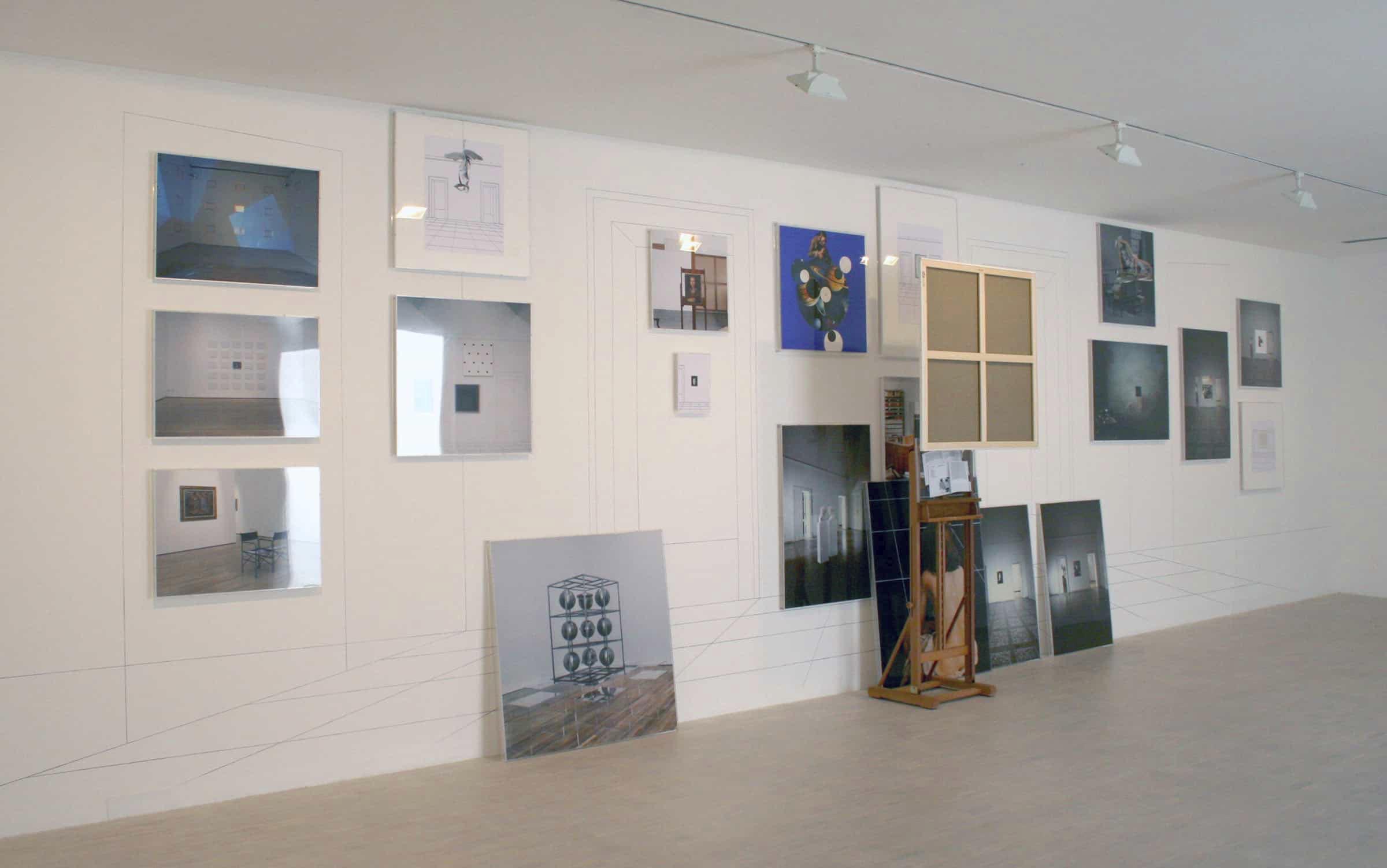
La vita eterna, 2007
GPO-0955
The Eternal Life
Photo prints in plexiglas cases, primed canvas, nylon thread, easel, xerox reproductions, pencil on wall
Twenty-two plexiglas cases in various dimensions, primed canvas 100 x 100 cm, overall dimensions variable
Private collection
Arranged on the wall drawing of a room seen in perspective, with two doors at the rear and the floor featuring a modular pattern, are multiple photographs in plexiglas cases (some of which resting on the ground).1 The images reproduce photomontages consisting of reproductions of works by Paolini set in exhibition rooms, in his own studio, or in an image of the same room outlined on the wall; other photographs offer views of the interventions conceived by Paolini in 2004 for the MART in Rovereto in conversation with works from the museum’s collection.2 A common denominator among the photographs is the citation of works by previous artists (including Antonio Canova, Lorenzo Lotto, Fausto Melotti, Joshua Reynolds, Jean-Antoine Watteau). Opposite the wall, in a central position, a primed canvas hangs from the ceiling by means of nylon threads, while an easel serves as the support of a plexiglas case that encloses the reproduction of two printed pages with the illustration of a work by Francis Picabia and excerpts taken from Giambattista Vico, Maurice Merleau-Ponty, and Jorge Luis Borges.3
The key to the interpretation of this “painting gallery” lies in the intimate link between Paolini’s works and those of past authors, without whom they would not have been possible (Giovane che guarda Lorenzo Lotto would not exist without Ritratto di giovane by Lorenzo Lotto; Mimesi without the Hermes of Praxiteles and so on). In other words: each work bears the memory of a previous work and is, in turn, the source of inspiration for a future work, one that is still unknown as the overturned canvas suggests; that is to say, each work of art is inscribed in the perpetuation in time of figures, ideas, and images, for a reciprocal exchange of gazes and stimuli (hence the title La vita eterna, The Eternal Life). This also explains the references to the excerpts from Vico, Merleau-Ponty, and Borges, in the spirit of a correspondence of ideas over time.
1 The line drawing reproduces a view of the hall of Paolini’s home in Turin, introduced in his own work in 1991 (cf. GPO-0681) and often returned to subsequently. The situation of the photographs arranged across the drawing on the wall recalls that of the work Senza data (1656-2005), 1999-2005 (GPO-0899), which similarly included the presence of Gala (from a painting by Salvador Dalì) in the role of viewer, seen from behind and seated on the ground.
2 Arranged from left to right and from top to bottom are the following photographs:
• three views of Paolini’s interventions at MART, Rovereto in 2004, in this order: the Fontana room, the Morandi room, and the de Chirico room (cf. GPO-0892);
• the figure of Antonio Canova’s Funerary Genius, used by Paolini in the series of works titled Aria (cf. GPO-0502), set against the background of the drawing of the hall in Paolini’s home;
• a detail from the work Senza data (1656-2005), 1999-05 (GPO-0899), with a canvas by Niele Toroni (top), L'ultimo quadro di Diego Velázquez, 1968 (GPO-0155), and a painting by Joseph Albers, Iridescent (Study for: Homage to the Square), 1965;
• set down on the floor is a view of the Melotti room created at the MART in 2004;
• in the area corresponding to the sketched door, at the top, the work E, 1963 (GPO-0041), set down on an easel in the artist’s studio;
• slightly lower down, Giovane che guarda Lorenzo Lotto, 1967 (GPO-0140) inserted in the detail of the drawing of the entrance hall in Paolini’s home reproducing the door to the left;
• the reproduction of a work on paper in the series Belvedere, unidentified up until now;
• a view of the work Mimesi, 1975 (GPO-0283) set in the hall of Paolini’s home;
• the work Dit autrefois “Gilles”, 1995 (GPO-0765) inscribed in the drawing of the same entrance hall;
• an image of the Self-Portrait, 1747-48 by Joshua Reynolds, set down on an easel in Paolini’s studio;
• set down on the floor, Gala by Salvador Dalì, from Ma femme nue regardant son propre corps devenir marche, trois vertèbres d’une colonne, ciel et architecture, 1945 (cf. GPC-0928);
• in the area corresponding to the drawn door, as a counterpoint to Giovane che guarda Lorenzo Lotto, the reproduction of Controfigura (critica del punto di vista), 1981 (GPO-0459) inscribed in the detail of the drawing of the entrance hall that reproduces the door to the right;
• set down on the floor, two views of the entrance hall in Paolini’s home inscribed, at the centre of the rear wall, with a reproduction, respectively, of L’invenzione di Ingres, 1968 (GPO-0154) and Autoritratto, 1968 (GPO-0152);
• a view of Requiem, 2004 (GPO-0888), taken in the solo show at Tucci Russo Studio per l'Arte Contemporanea, Torre Pellice, 2004;
• a view of the work L'Île enchantée, 2006 (GPO-0768);
• two views of the entrance hall in Paolini’s home, with inserted, at the centre of the rear wall, a reproduction, respectively, of Autoritratto, 1968 (GPO-0151) and Lo studio, 1968 (GPO-0156);
• the drawing of the entrance hall in Paolini’s home, with inserted, at the centre of the rear wall, a reproduction of the twelve plates making up the portfolio Les fausses confidences, 1983 (GPE-0042).
3 The images reproduce the two double pages conceived by Paolini for the group exhibition catalogue of Gennaio 70. Comportamenti progetti mediazioni. 3a biennale internazionale della giovane pittura, Bologna, Museo Civico, 1970 (cf. GPO-0197). The passage from Vico is an extract from his Principii di Scienza Nuova, book II: Della sapienza poetica, section II, chap. I, 401-402; cf. G. Vico, Opere, tome I, I Meridiani (Milan: Arnoldo Mondadori Editore, 1990), pp. 585-86. The quotation from Merleau-Ponty is from Le doute de Cézanne [Cézanne’s Doubt] (1945); cf. M. Merleau-Ponty, Senso e non-senso (Milan: Il Saggiatore, 1962), pp. 36-37. The text by Borges is taken from the collected works entitled El hacedor [The Maker] (1960); cf. J.L. Borges, Tutte le opere, vol. I (Milan: Mondadori, 1984), p. 1141.
| 2007 | Milan, Giò Marconi, Giulio Paolini, 4 May - 27 July. |
| • | G. Iovane, “Il museo senza muse / A Museum without muses”, in Janus 23 (Brussels), January, 2008, col. repr. p. 63. |

