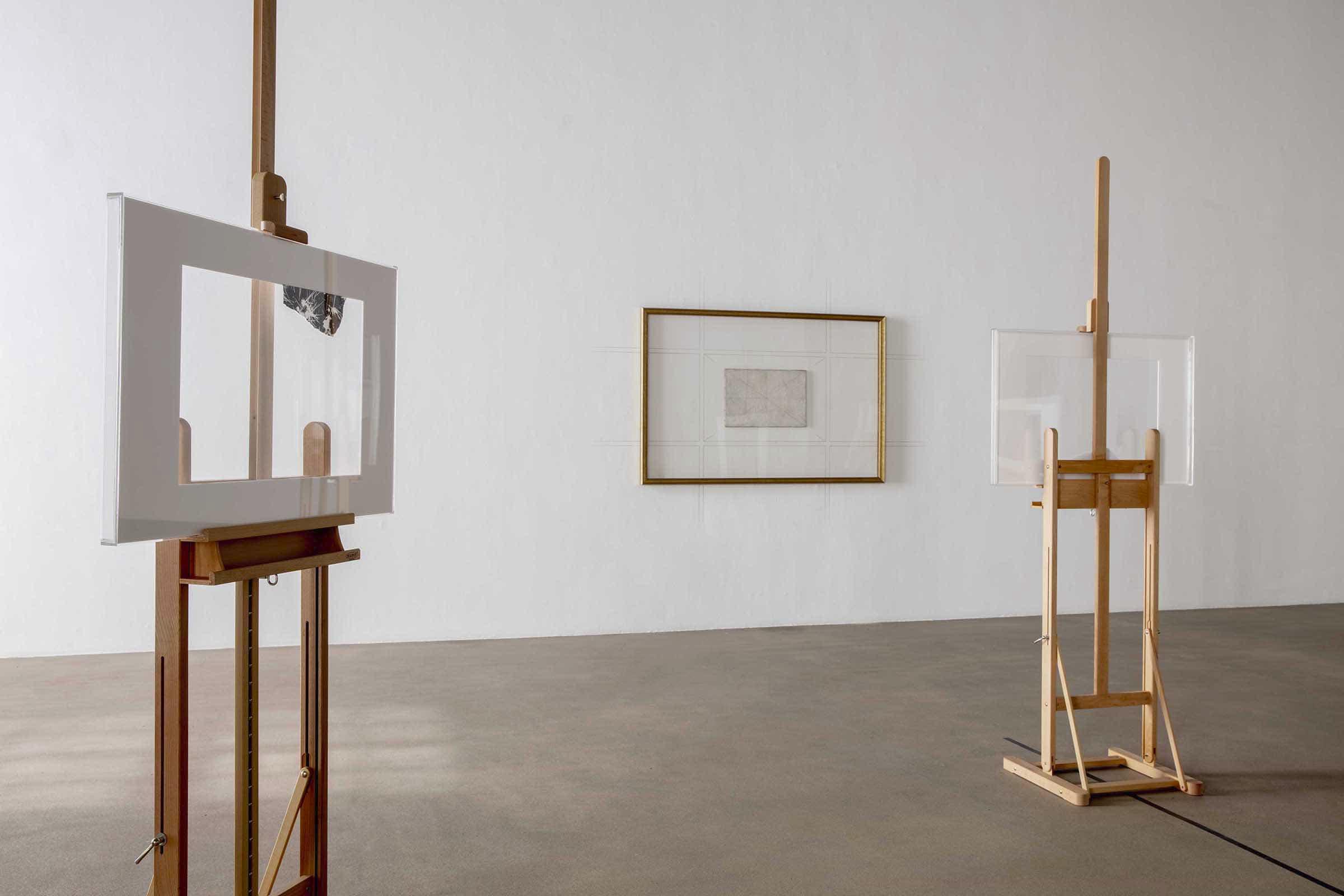
Le Chef-d’œuvre inconnu, 2020
GPO-1100
Easels, plexiglas cases, collage on passepartout, torn photographic reproduction, red adhesive tape and black adhesive tape on the floor, gilt frames, photo print mounted on Dibond, pencil on wall
Overall dimensions site-specific
Castello di Rivoli Museo d’Arte Contemporanea, Rivoli-Turin
Gift of the artist, 2020
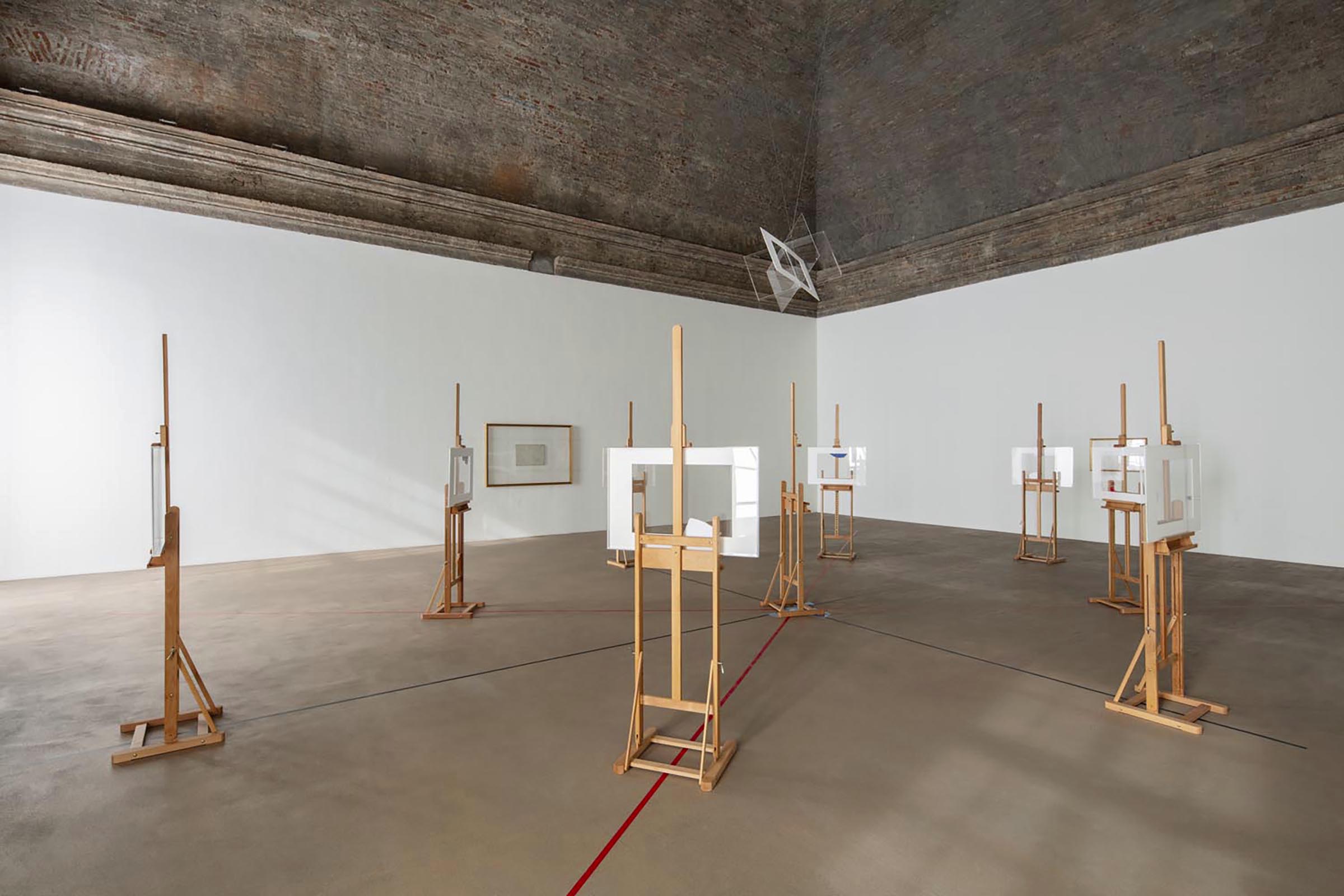
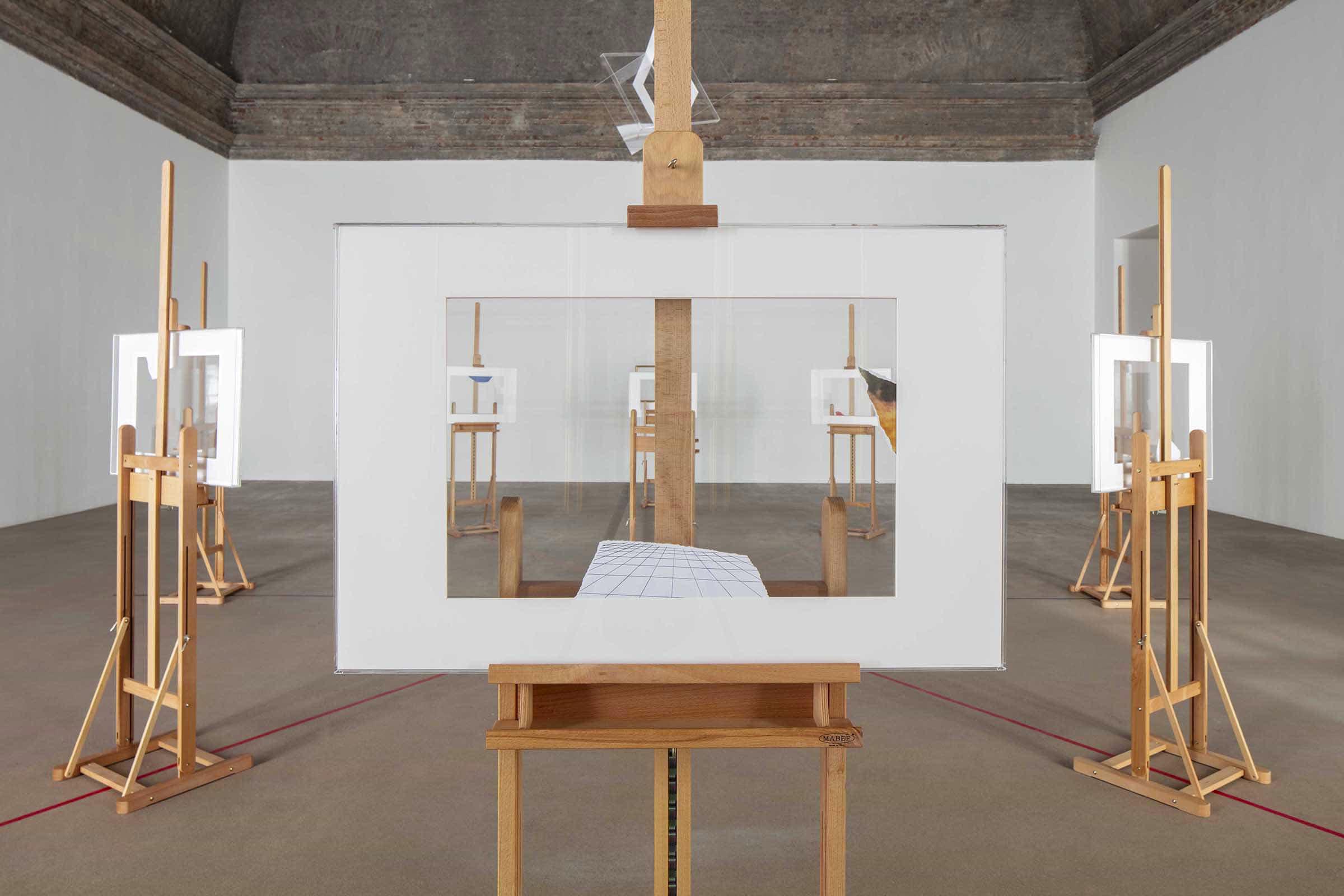
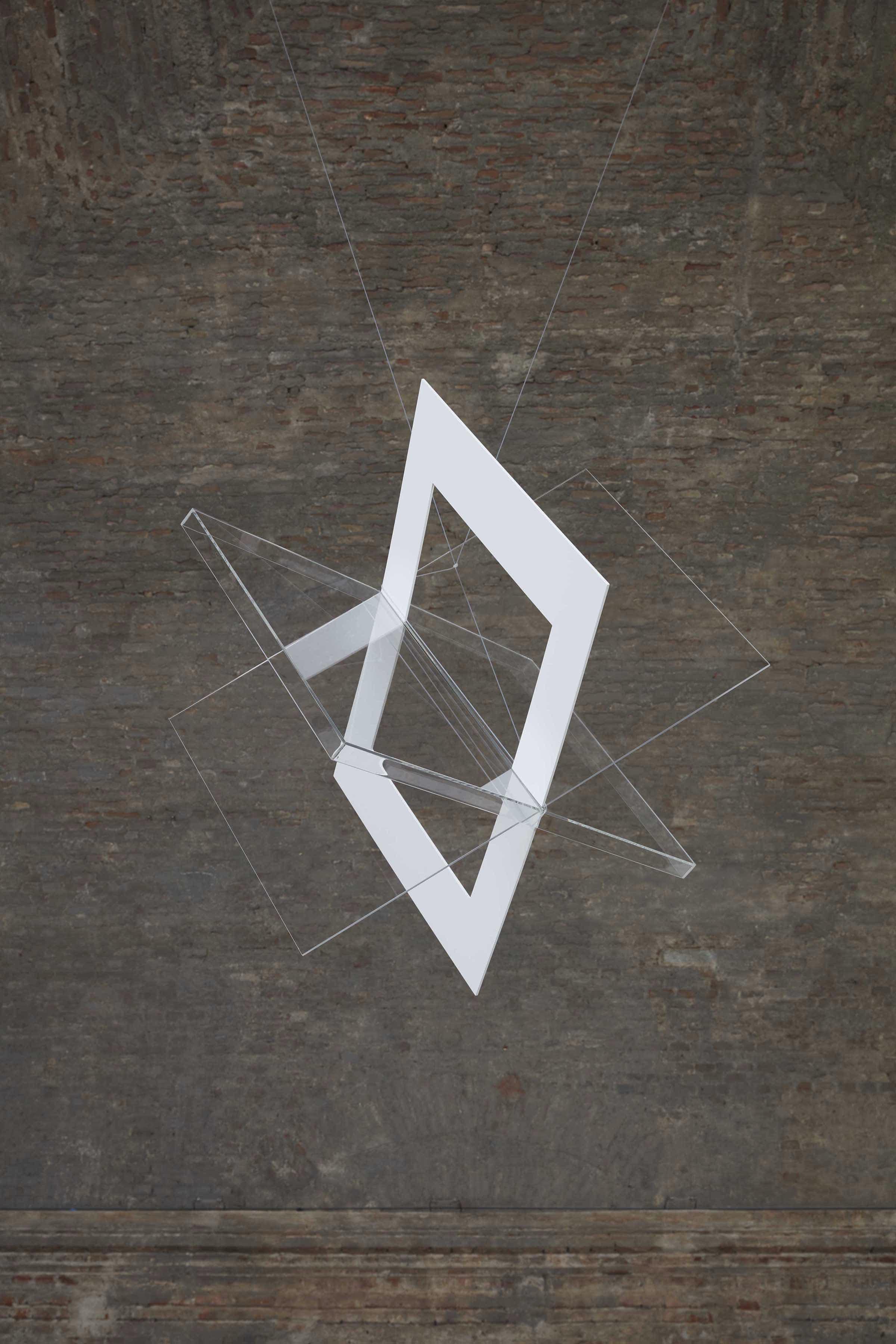
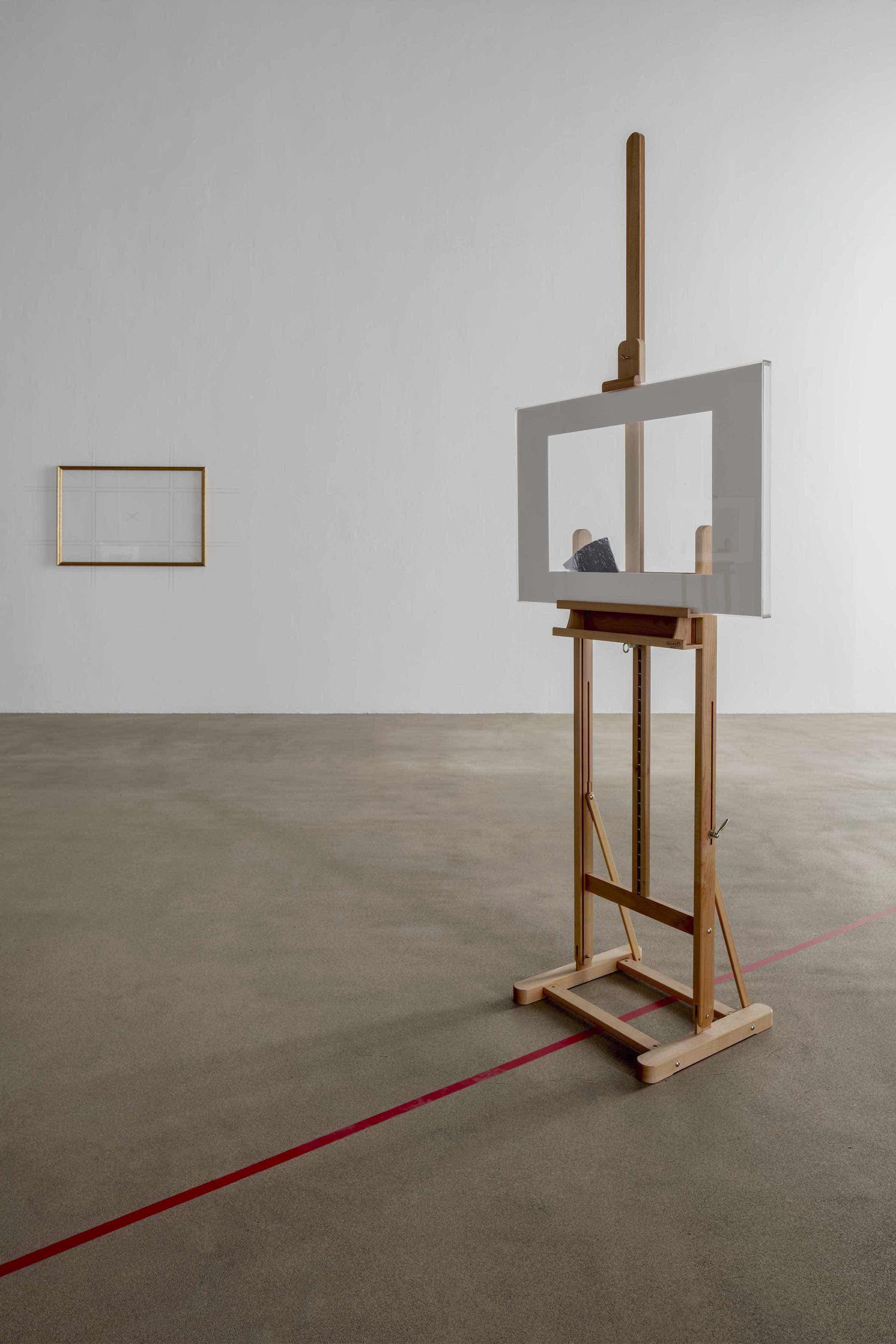
The work transposes on a site-specific scale the squaring made by the artist in his first painting, Disegno geometrico, 1960 (GPO-0001). On the ground, tape is used to mark the two diagonals (red) and the median axes (black), respectively. Four easels occupy the vertices and the perimetral median points of the squaring, while four other easels indicate the points located along the diagonals (corresponding to the arcs of the compass in the 1960 painting). Lastly, the ninth easel marks the centre. Each easel – with the exception of the one in the middle – holds a plexiglas case with a white passepartout, as well as one or more photographic fragments that from the edges overlook the cut-out (the details are taken from repertory images used by the artist for his own works). The easel at the centre is instead associated with a plexiglas case with a passepartout, whose components have been taken apart and hang from the ceiling. Arranged on the floor, under the easel, are the torn fragments of a photographic reproduction of the sky.
Moreover, at the centre of each side of the room four different wall interventions feature an orderly pattern of drawn squares, integrated with golden frames and intended as hypothetical variants of Disegno geometrico. The latter, for its part, is reproduced in its actual size in the image included in one of the four episodes.
With this new interpretation of his "debut work", six decades later, Paolini does not just amplifies the image of that first painting – turning it into a space that can be walked along – but its potential and assumptions as well. The easels and the marks on the ground, as well as the drawings on the wall that multiply the original module underscore the basic concept of Disegno geometrico: the squaring (de)signs the space of the representation that is meant to contain any figure or image. Similarly, the cutout of the passepartout accentuates the window that can contain any representation, evoked via the fragments of images. Before this scenic space, designed to host a visual event, we viewers remain in a condition of waiting: indeed, the focal point of the installation is suspended above, literally keeping suspended the possibility that something may or may not be deposited in a complete vision. This completeness is evoked by the photographic details of the sky, intended as the symbolic echo of an absolute dimension.
Just as the artist's debut work in 1960 was limited to offering the lines of a potential representation, Le Chef-d’œuvre inconnu presents, as a whole, the scaffolding of a presumed work – the stage of a performance to come, the outline for a plot yet to be written – limited, that is, to heralding an "unknown masterpiece". Unlike the debut work, nonetheless, the ninth version insinuates – by means of the ruined fragments of sky on the ground – the illusoriness of the, albeit inexorable, wait: the “unknown masterpiece” is broken up the minute we think we recognize it, as we are reminded by the title that cites the short story with a notoriously tragic ending by the French writer Honoré de Balzac.
1 For the first presentation of the work at Castello di Rivoli in 2020 the original painting, instead of its photographic reproduction, was temporarily on loan.
Title from Honoré de Balzac, Le Chef-d’œuvre inconnu, 1831.
| 2020-21 | Rivoli, Castello di Rivoli Museo d’Arte Contemporanea, Giulio Paolini. Le Chef-d’œuvre inconnu, 15 October 2020 - 16 May 2021, vol. 1: cited in the checklist of exhibited works p. 78, col. repr. pp. 18-25 (details), 26-29, 44, 48-49 (exhibition views), 51, 52 (details), 94-95 (projects), referred to in the texts by C. Christov-Bakargiev pp. 37-42, M. Beccaria pp. 47, 50, 53. |
| • | G. Paolini, Eccomi. Qui dove sono (Turin: Fondazione Giulio e Anna Paolini, 2025), p. 84 (unpublished statement written in 2020). |
| • | Paolini. I Grandi illustrati del Corriere della Sera. Arte contemporanea – I protagonisti 8, edited by F. Gualdoni (Milan: RCS MediaGroup S.p.a., 2022), p. 80, col. repr. pp. 80-81. |
| • | Giulio Paolini. A come Accademia, exhibition catalogue, Rome, Accademia Nazionale di San Luca (Rome: Gangemi Editore, 2023), col. repr. pp. 288-289 (exhibition view Rivoli 2020). |
| • | Praemium Imperiale 2022. In honour of Prince Takamatsu (Tokyo: The Japan Art Association, 2023), col. repr. p. 11 (exhibition view Rivoli 2020). |
| • | Castello di Rivoli Museo d’Arte Contemporanea. La storia e le collezioni, edited by C. Christov-Bakargiev and M. Beccaria, Rivoli, Castello di Rivoli Museo d’Arte Contemporanea (Turin: Umberto Allemandi & C., 2023), vol. I, p. 48 (referred to in the text by M. Beccaria), not repr.; vol. II, pp. 821-822 (referred to in the text by M. Beccaria), col. repr. pp. 832-833. |
| • | M. Beccaria, “Il modello in persona (senza parlare degli altri)”, in Giulio Paolini. Et in Arcadia ego, exhibition catalogue, Verona, Galleria d’Arte Moderna Achille Forti (Imola: Manfredi Edizioni, 2024), p. 61, col. repr. p. 60 (detail). |
| • | G. Paolini, Eccomi. Qui dove sono (Turin: Fondazione Giulio e Anna Paolini, 2025), col. repr. p. 85 (exhibition view Rivoli 2020). |

