Senza più titolo, 2010
GPO-0999
No Longer Titled
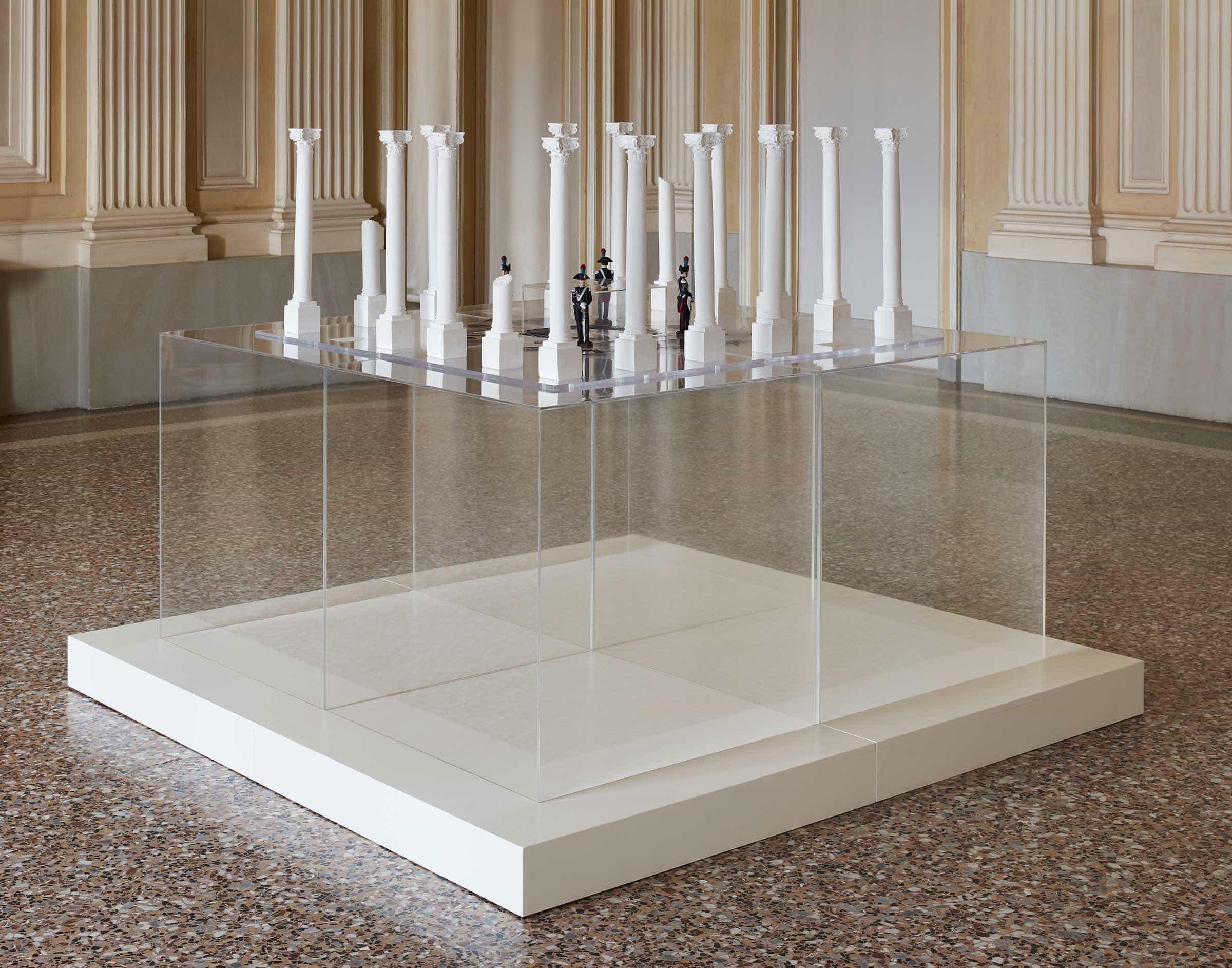
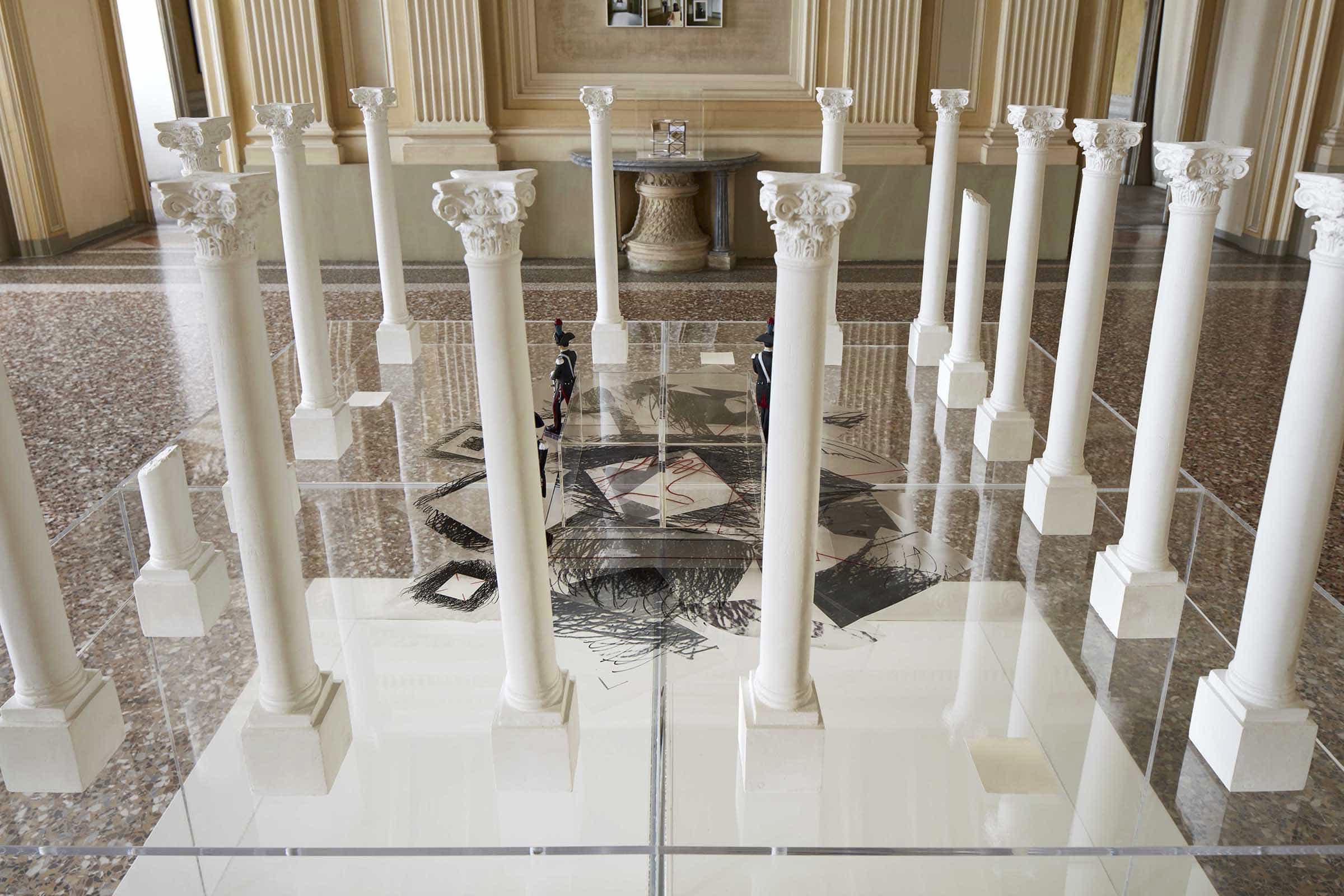
White-painted wooden base, plexiglas volumes and sheets, collage on plexiglas, plaster casts of whole and broken columns, xerox reproductions and red ink on acetate, miniature statues of policemen
Four wooden parts 15 x 110 x 110 cm each, four plexiglas volumes 90 x 90 x 90 cm each, four plexiglas sheets 70 x 70 cm each, two cases 14 x 29 x 15 cm each, fourteen whole columns h 59 cm each, three broken columns at various heights, four small statues h 22.5 cm each, overall dimensions 165 x 220 x 220 cm
Collection of the artist
Situated atop four plexiglas cubes placed close together on a white platform, a plaster colonnade of a temple undergoing construction or in ruin – some of the columns are missing, others are broken – delimits a space occupied at the centre by a small transparent volume evoking a "cell". This "cell" is, in turn, presided over at the vertices by four statuettes of military police is uniform. Strewn about in the central area are undecipherable drawings reproduced on acetate, which in the area corresponding to the empty "cell" feature several squares in red ink. The squares are staggered, and the profile of a life-size hand appears to want to hold them.
In the heart of this "sacred place", the author's hand attempts to fix that Absolute that escapes every chance for appropriation and definition, rediscovering a recurring gesture in several of Paolini's works. Broadly speaking, Senza più titolo offers a reflection on the deeply "other" dimension of a work of art. The archetype of the temple and of the cell (the naos where the statue of the deity was kept) bring back the ideality of the work to its classical origins, to its inviolability and mystery. Stripped of its features, either lost or forgotten, and dispossessed even of the title that identifies it, the work is "no longer titled”. Emptied of every contingent meaning it reflects on its own ultimate reason for existing. That is: it upholds its exile from the world, its extraneousness to any direct contact, its intimate belonging to a dimension regulated by a secret code. All the author as well as the spectator can do is listen to the imperceptible echoes in between the columns of the uninhabited temple, and grasp the shadows and reflections drawn by the light between the empty plexiglas volumes and the white surface of the platform.
| 2010-11 | Lugano, Studio Dabbeni, Giulio Paolini, 12 November 2010 - 26 February 2011, col. repr. in temporale 70 (Lugano), November, 2010, pp. 26-27 (detail), 36-37 (exhibition views). |
| 2020-21 | Rivoli, Castello di Rivoli Museo d’Arte Contemporanea, Giulio Paolini. Le Chef-d’œuvre inconnu, 15 October 2020 - 16 May 2021, vol. 1: cited in the checklist of exhibited works p. 78, col. repr. pp. 32-35 (exhibition views), 59 (detail), referred to in the texts by C. Christov-Bakargiev p. 42, M. Beccaria p. 61. |
| • | G. Paolini, “Senza più titolo (Prova di esistenza in vita: oggi, 12 November 2010)”, in temporale 70 (Lugano), November, 2010, pp. 30-31. |
| • | A. Soldaini, “‘Cos’altro c’è da dire?’”, in Giulio Paolini. A come Accademia, exhibition catalogue, Rome, Accademia Nazionale di San Luca (Rome: Gangemi Editore, 2023), pp. 33-34, col. repr. pp. 33, 293 (exhibition views Rivoli 2020). |

