Vite parallele, 2007
GPO-0954
Parallel Lives
Easels, xerox reproductions in plexiglas cases and placed between two plexiglas sheets, primed canvases, empty plexiglas cases, collage on reversed canvas and on wall, pencil on wall
Overall dimensions variable
Attilio Codognato Collection, Venice
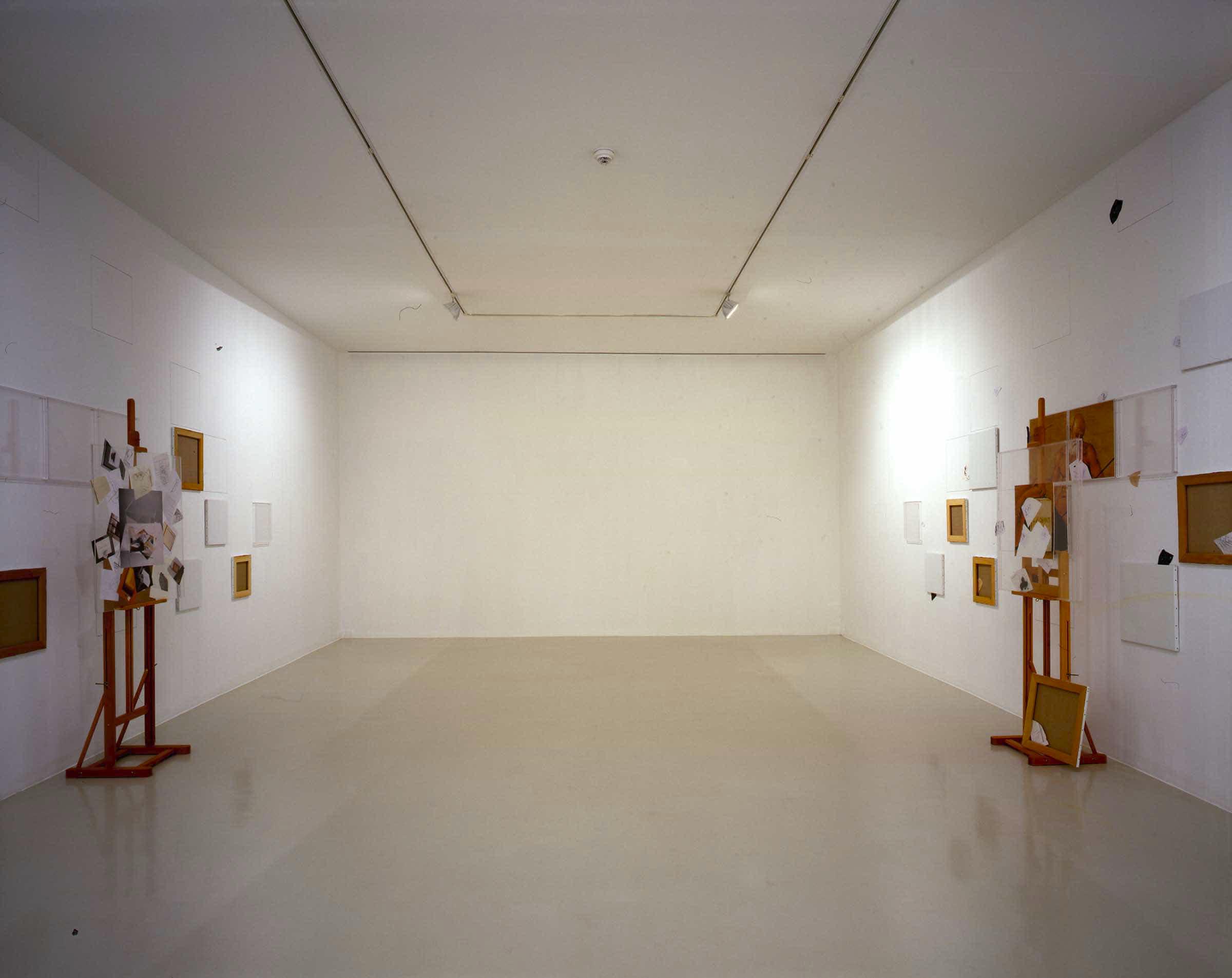
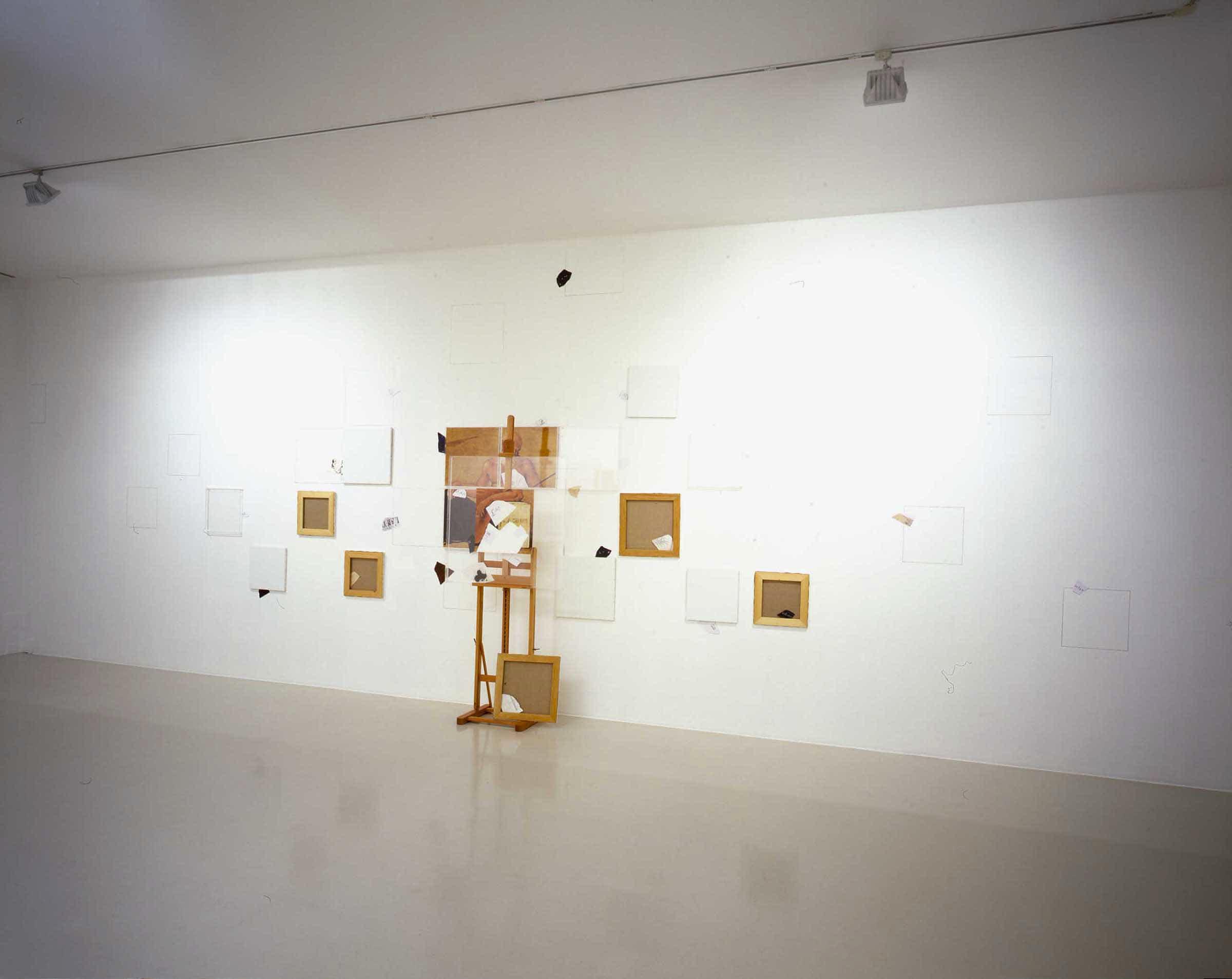
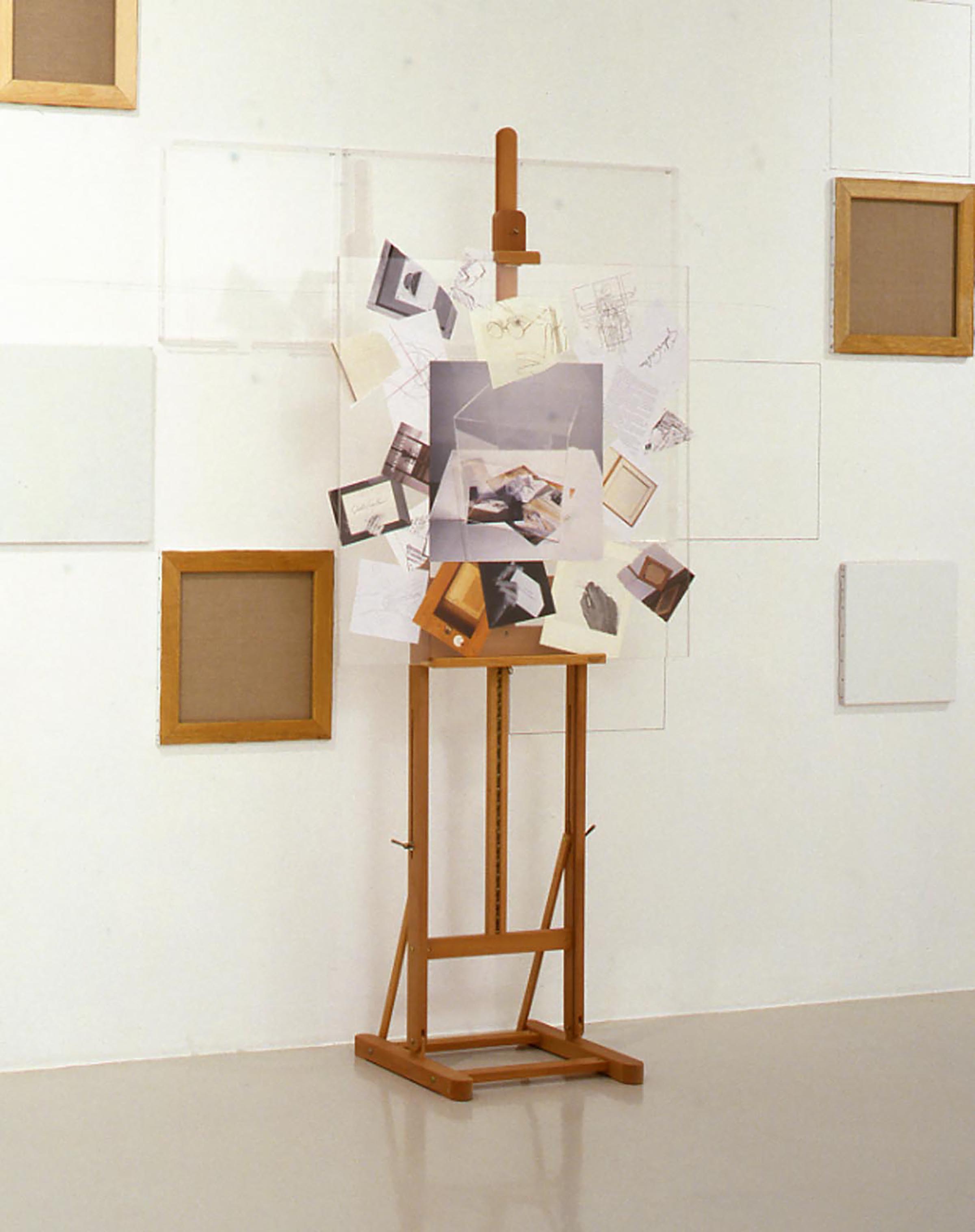
The work consists of two parts installed so that they face each other on two opposite sides of a room, called A and B here. Each part is made up of a pattern of square elements arranged on the wall, serving as a background to the images displayed on the easel standing before the wall.
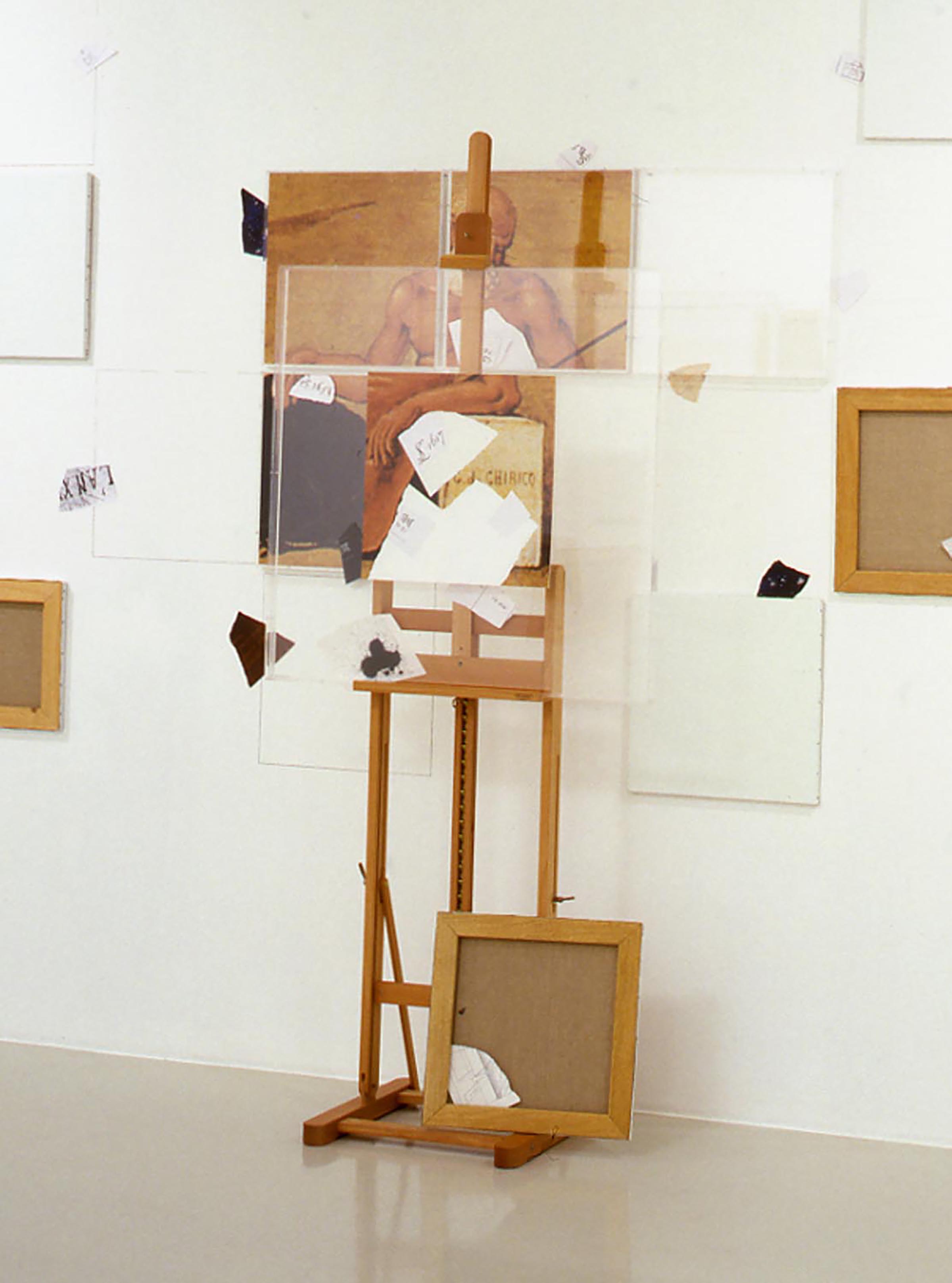
Side A pays homage to a vast horizon of artists from all ages. On the wall, in the area corresponding to the easel and divided among three plexiglas cases, is the image of Chronos, the Titan god of time, taken from a painting by Giorgio de Chirico (the fourth detail is enclosed in the case on the easel). Extending from this core of images, up to the far ends of the wall, is an irregular “checkerboard” arranged in four rows, made up of three plexiglas cases and nine recto/verso primed canvases in two different sizes; as these elements extend outwards with longer intervals in between them they make room for several squares drawn in pencil (the ones farthest out end where the wall itself ends, thereby indicating their potentially limited continuity). Most of the “paintings” in this “picture gallery” are associated with the torn fragment of a monogram or the date of a painting by an artist from the past. On the easel standing before the wall a plexiglas case contains the fourth photographic detail of de Chirico’s painting (missing in the cases displayed on the wall), featuring the author's signature, and other reproductions of monograms of artists from the past.1 Propped up at the foot of the easel is a reversed canvas, which likewise contains the reproduction of a monogram.
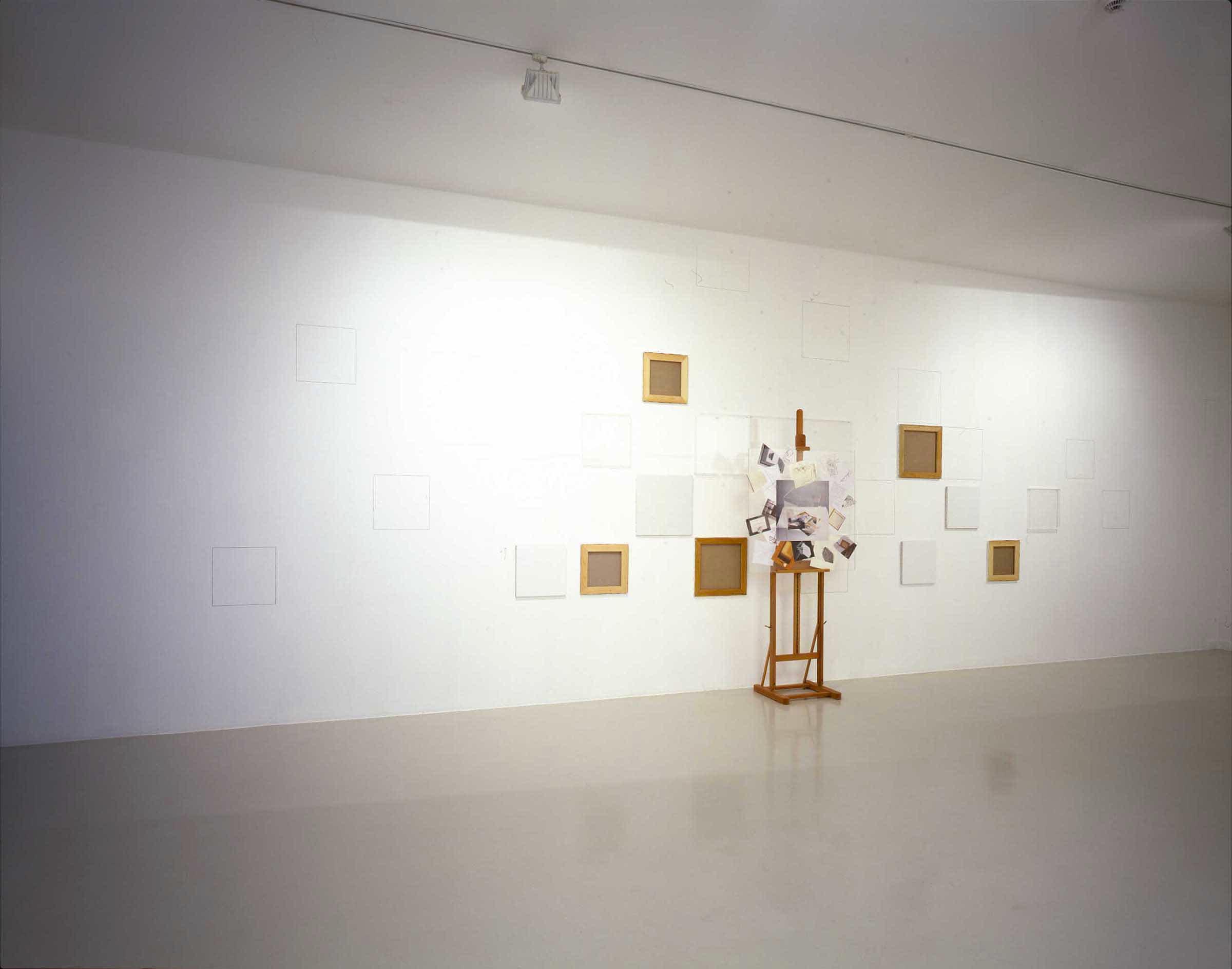
The protagonist of Side B is Giulio Paolini himself. The situation on the wall mirrors that of side A, but the central cases are empty. On the easel, two plexiglas sheets withold several images related to works, drawings, signatures or writings by Paolini, including, above centre, the detail of a drawn self-portrait, which depicts him with his hand on his face. In his melancholy position he serves as a counterpoint to the figure of Chronos on side A.2
The two specular situations create a relationship – or a parallel, the word used in the title after the work of the same name by Plutarch – between the “life” of the artist and that of his other “travel companions”, thus including it in a line of descent that has neither a beginning nor an end. In the artist's own words: "Two, a thousand, all artists have perhaps only one name: the centuries that separate them seem to be amply compensated by the light-years that join them together”.3 “Artists – all artists – are one, the same person who is embodied in different times and places, in many different individuals: the attempt to imitate, gather in full the model that they only glimpse or that they do not admit to recognizing as ‘truth’, confines them to the exercise of a parallel story or history – the History of art”.4
1 The detail of de Chirico’s signature is taken from his Il saluto degli Argonauti partenti [The Farewell to the Departing Argonauts] (1920); “G. de Chirico / pinxit” is inscribed on the milestone against which Chronos is leaning. Also included with the fragments superimposed upon or scattered around the image of de Chirico’s signature is a torn reproduction of Francis Picabia’s La Sainte Vierge II (1902).
2 The image of the face traced from a portrait taken by photographer Gérard Amsellem in 1983 and outlined so that it overlaps a photograph of a pile of drawing sheets was made into a lithograph in 1989 for a series of works on paper entitled Senza titolo (Ni le soleil ni la mort...) (cf. from GPC-0752 to GPC-0759, see also the print GPE-0082). At the centre of the eighteen images gathered between the two plexiglas sheets is a colour reproduction of the “self-portrait” entitled Il nome proprio, 1986 (GPO-0574, version Winterthur 2005), while following one another all around clockwise from the top towards the right are: a drawing of a male figure in tails, multiplied in different positions, against the background of a pattern of square modules; an autograph signature; a printed page of one of the artist’s writings; a fragment of an undecipherable drawing; a photographic detail of Senza titolo, 1963 (GPO-0026); a photographic detail of Capitemi!, 1966 (GPO-0112); an edition of the lithograph Vedo (la decifrazione del mio campo visivo) made in 1973 for issue 31 of the magazine Bolaffiarte; a black and white photographic reproduction of the collage Et quid amabo nisi quod ænigma est?, 1969 (GPC-0172); an image of the verso of E, 1963 (GPO-0041); a reproduction of Studio per "Quadrante", 2002 (GPC-1010); a drawing with fragments of autograph writing; the invitation to the 1975 solo show at the D’Alessandro/Ferranti gallery in Rome; a reproduction of the exhibition catalogue Giulio Paolini, Como, Fondazione Antonio Ratti (Milan: Edizioni Charta, 2003); a reproduction of another Studio per "Quadrante", 2002 (GPC-1008); the detail of an autograph signature; a torn photographic black and white reproduction of the verso of Senza titolo (6890), 1964 (GPO-0065), and, lastly, another drawing with fragments of autograph writings.
3 G. Paolini interviewed by L. Pratesi, in Incontri, exhibition catalogue, Rome, Galleria Borghese (Milan: Edizioni Charta, 2002), p. 96.
4 G. Paolini, Quattro passi. Nel museo senza muse (Turin: Giulio Einaudi editore, 2006), p. 60.
• Francis Picabia, La Sainte Vierge II, 1920, Indian ink on paper, Bibliothèque Doucet, Paris.
• Giorgio de Chirico, La partenza degli Argonauti, 1920, tempera on canvas, 54 x 73 cm, Fondazione Francesco Federico Cerruti per l’Arte Collection. Long-term loan at Castello di Rivoli Museo d’Arte Contemporanea, Rivoli.
• Jean-Auguste-Dominique Ingres, Philibert Rivière, 1804-05, oil on canvas, 116 x 89 cm, Musée du Louvre, Paris.
• Q. Lollius Alcamenes, mid-1st century AD, marble funerary relief, 25 x 33 cm, Villa Albani, Rome; reproduction from Opere di G. G. Winckelmann, prima edizione italiana complete, vol. XIII (Prato: Fratelli Giachetti, 1830-34), plate CLXV, no. 364 (“Quinto Lollio Alcamene Scultore”).
• Images of the monograms from Frantisek Subert, Irah Subertova-Kucerova, I monogrammi dei pittori dal XV al XVII secolo (La Spezia: Fratelli Melita, 1990).
• Title from Plutarch, Parallel Lives, end of the 1st century AD - beginning of the 2nd century AD
| 2007 | Milan, Giò Marconi, Giulio Paolini, 4 May - 27 July. |
| • | G. Iovane, “Il museo senza muse / A Museum without muses”, in Janus 23 (Brussels), January, 2008, col. repr. pp. 62 (side A and B), 63 (side A). |

