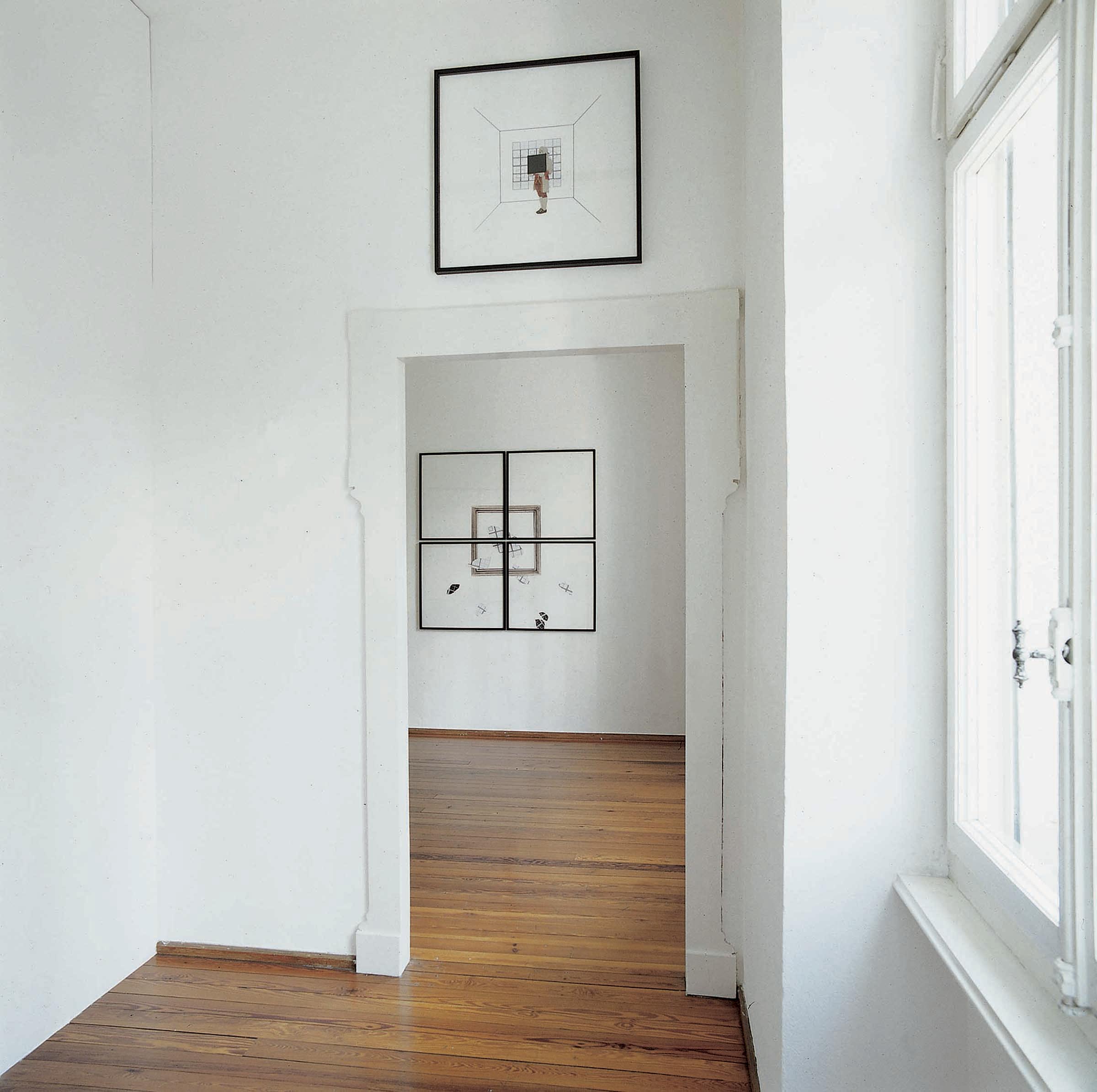
Finale di partita, 2007
GPO-0951
Endgame
Pencil, red pencil and collage on paper, plexiglas sheets, easel
Twenty-four framed elements 70 x 70 cm each, collage 40 x 60 cm moubnted between two plexiglas sheets 60 x 89.5 cm each, overall dimensions variable
Private collection
From 2007 to 3 January 2019 on loan at MASI Museo d’arte della Svizzera italiana, Lugano, inventory no. MCA 2007/0133
The display of the framed elements on one or several walls varies depending on the exhibition itself and the amount of space available. What cannot be altered is the division of the twenty-four elements into distinct iconographic groups (four quartets and four dyptichs that are predefined; the diptychs can be placed close together to form two quartets). Inside each group, the framed elements must be arranged close together (but never touching).
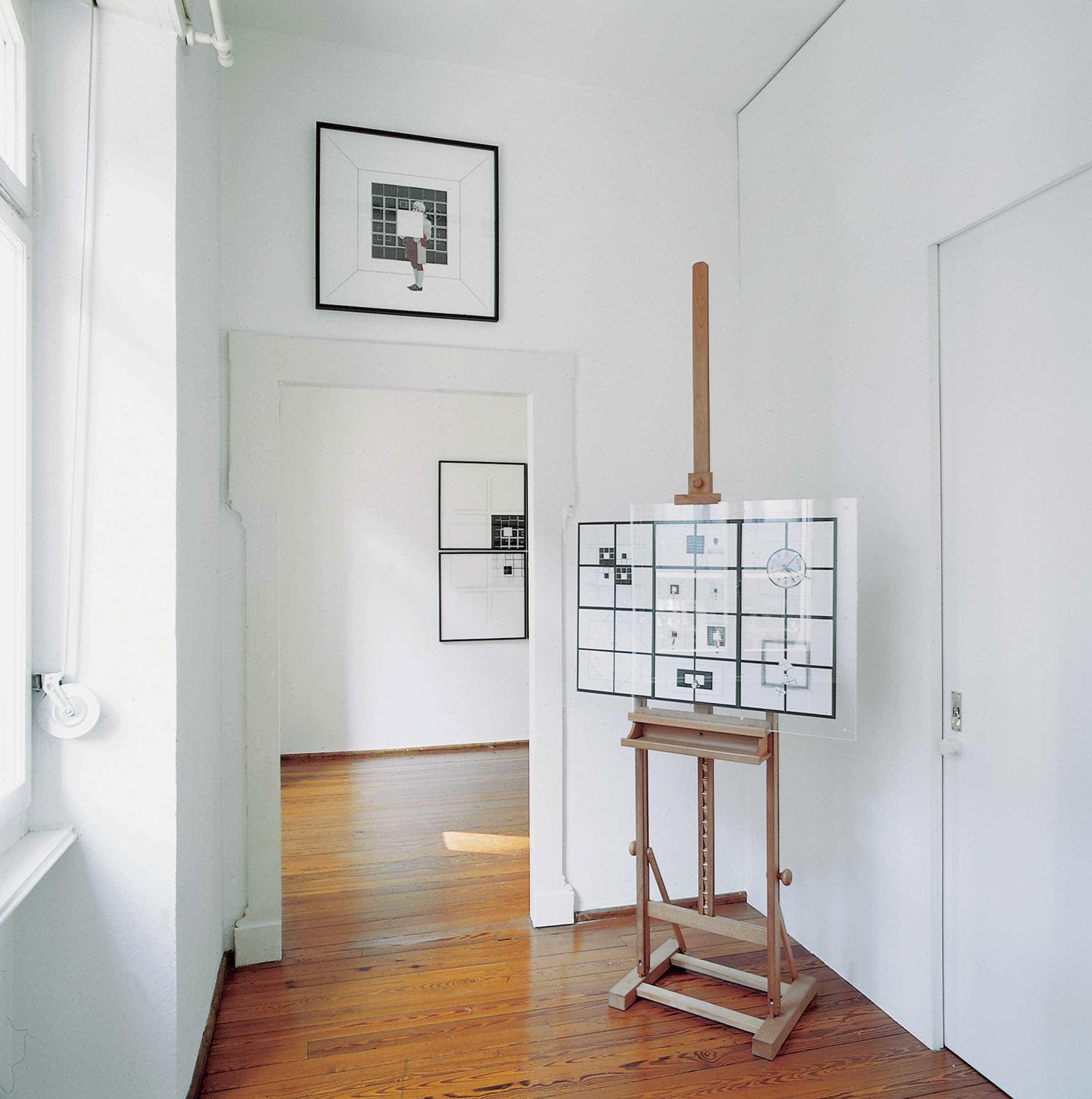
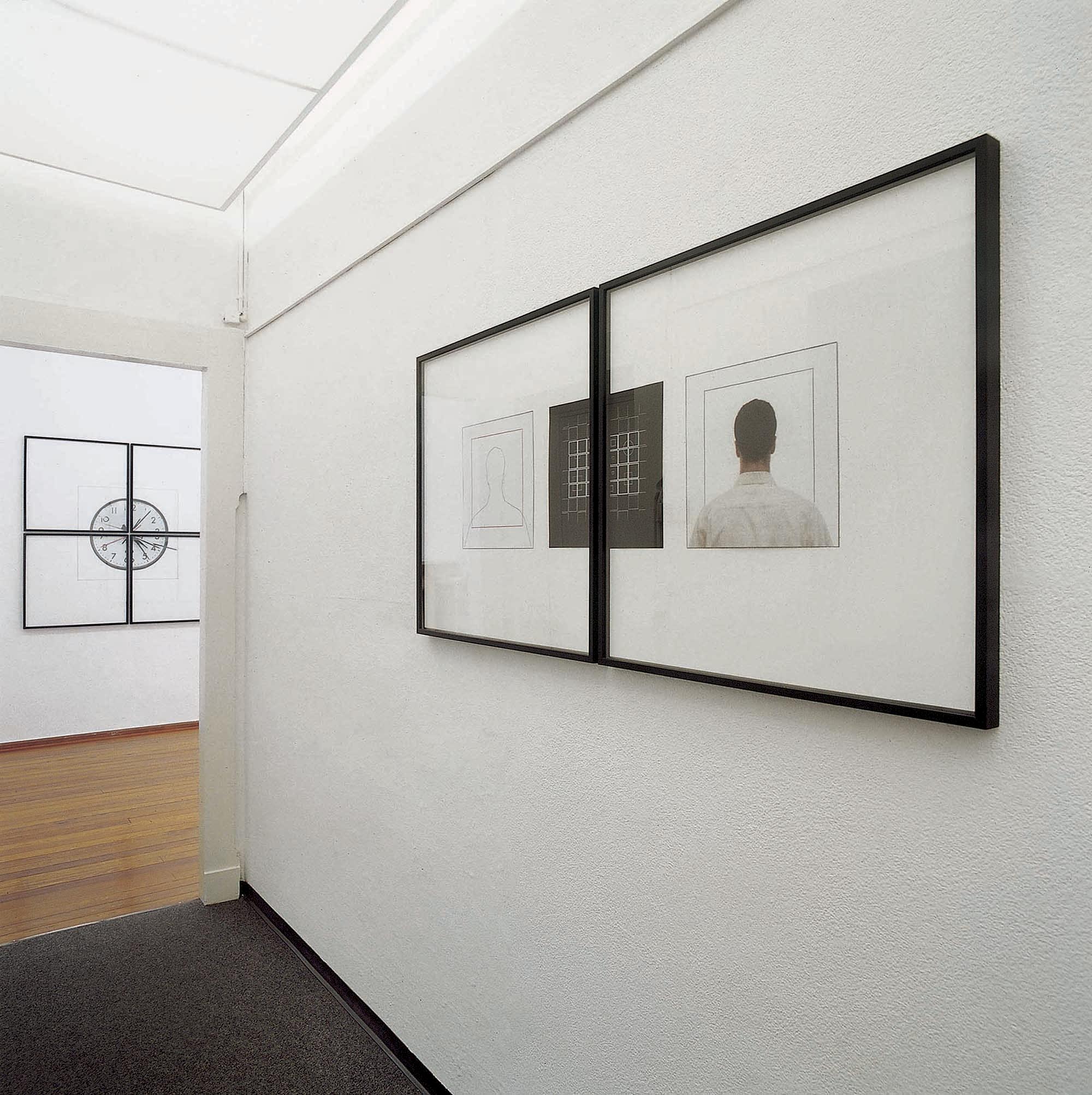
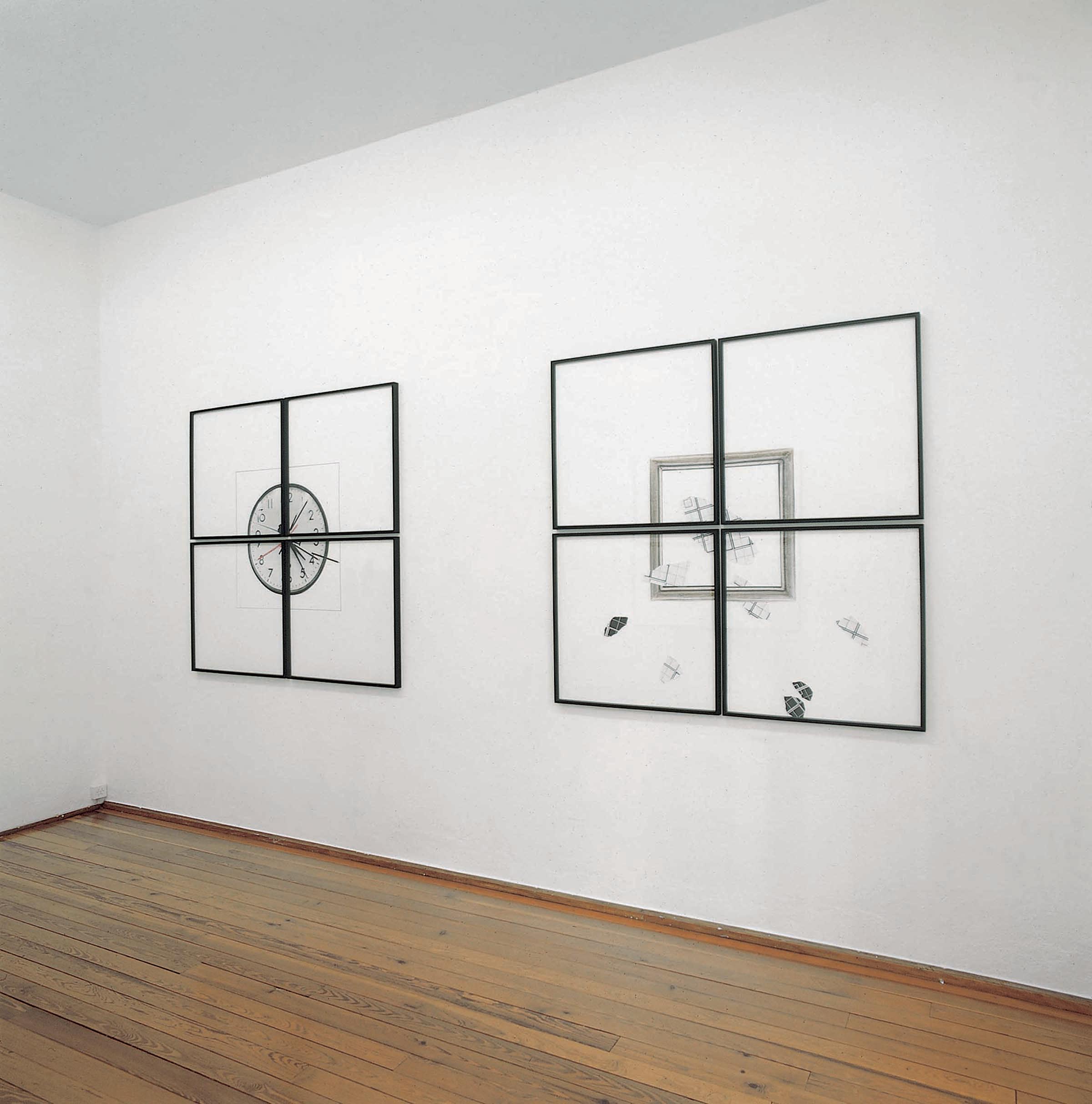
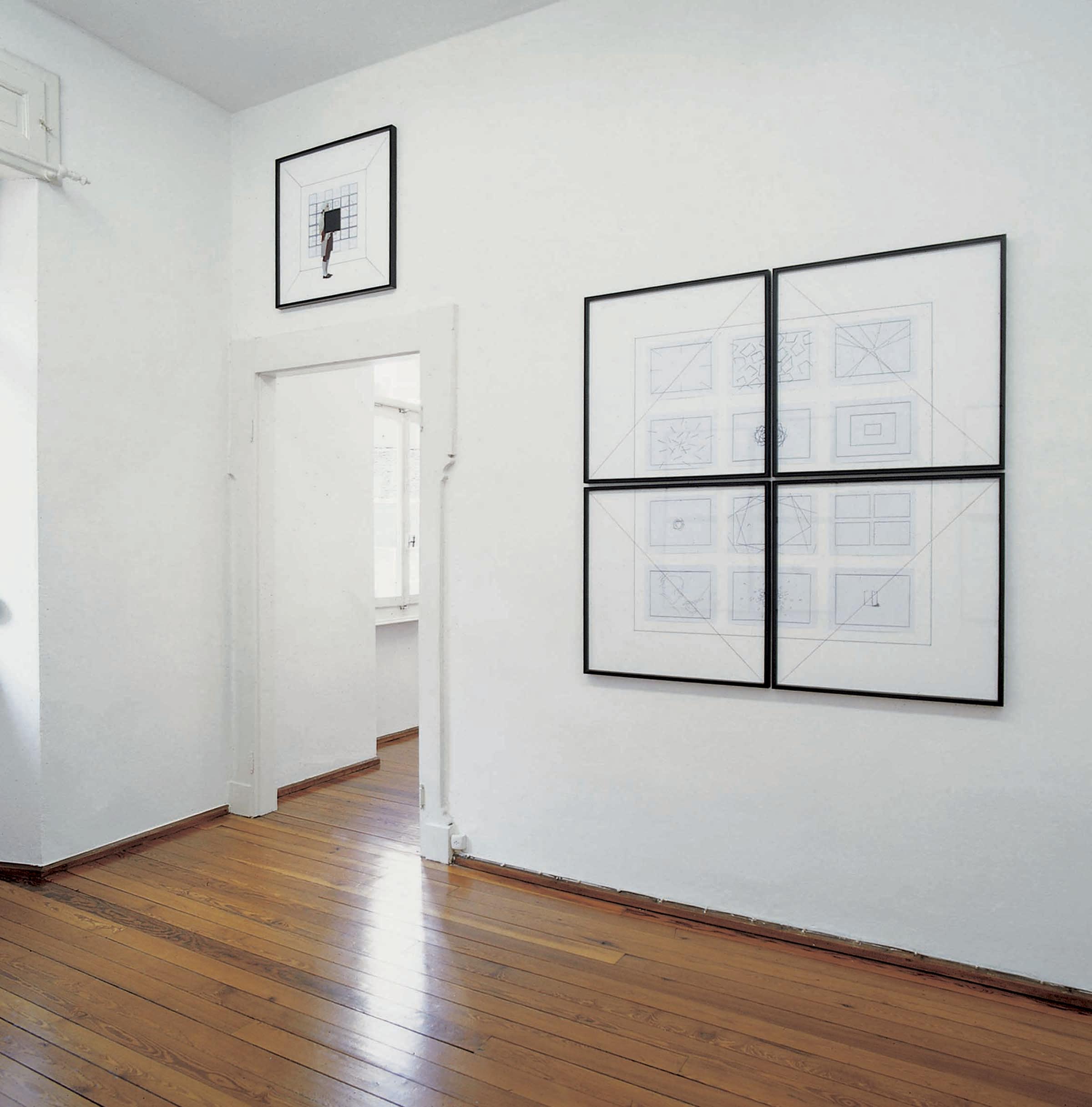
• 2007, Lugano, Studio Dabbeni: eight theme-based groups (four quartets and four diptychs) are arranged on the walls of three adjacent rooms; the easel is placed in the passageway between the two main spaces; the elements with the valets are arranged individually above the two doors connecting the exhibition spaces.
• 2024, Milan, Università Bocconi: six iconographic groups (the diptychs are placed close together to form two quartets) are distributed irregularly on a single large wall; the easel is located before the wall, to the right.
Twenty-four framed elements, all featuring the same square format, with interventions in pencil, red pencil, and collage, are divided into eight theme-based groups – four quartets and four diptychs – to be arranged variably on one or more walls of an exhibition space. Each group suggests – in the ensemble of elements placed close together – a motif or a theme that is characteristic of the artist's iconography, prevalently formulated via the complementary black-white or positive-negative relationship (drawings of squares, pairs of valets, a watch with several pencils, a frame associated with the falling of torn fragments and other subjects). The ensemble of twenty-four elements is envisioned, in a reduced scale, in the project – whose size is the same as that of the artist's first painting, Disegno geometrico (1960, GPO-0001) – held between two plexiglas sheets on an easel.
The title – borrowed from a Samuel Beckett play, and used for the first time for a work that was made in 2006 (GPO-0938), indicates the final part of a game of chess.
Between the “chessboard” on the easel and the "figures" arranged on the wall, what's at stake is the open game that represents the becoming of the work of art. The theory of hypotheses, the combinatory game of square modules that seem to be composed and multiply unbeknownst to the author, recall the labyrinthine plan, the vertigo and at the same time the enthrallment of the dimension that precedes the accomplishment of the final configuration. A dimension that conceptually rediscovers that of Disegno geometrico, the painting of all paintings, understood to be a potential container or virtual stage of every representation.
• Image of the timepiece from Samuel Abraham Goudsmit, Robert Clairborne, Quarta dimensione: tempo (Milan: Arnoldo Mondadori Editore, 1967), p. 8 (”L’ora ufficiale americana”).
• Portrait of Giulio Paolini taken by Anna Piva, 1972.
• Title from Samuel Beckett, Fin de partie (Paris: Éditions du Minuit, 1957).
| 2007 | Lugano, Studio Dabbeni, Enrico Castellani, François Morellet, Giulio Paolini, 19 April - 2 June, documentation in temporale 64-65 (Lugano), 2007, col. repr. pp. 14-17 (exhibition views). |
| 2024-25 | Milan, Università Bocconi, Bocconi Art Gallery 2024, 18 September 2024 - April 2025, col. repr. n. pag. (exhibition view, incorrect installation). |
| • | G. Paolini, “Finale di partita”, in temporale 64-65 (Lugano), [June] 2007, p. 17. |

