Senza data (1656-2005), 1999-05
GPO-0899
Undated (1656-2005)
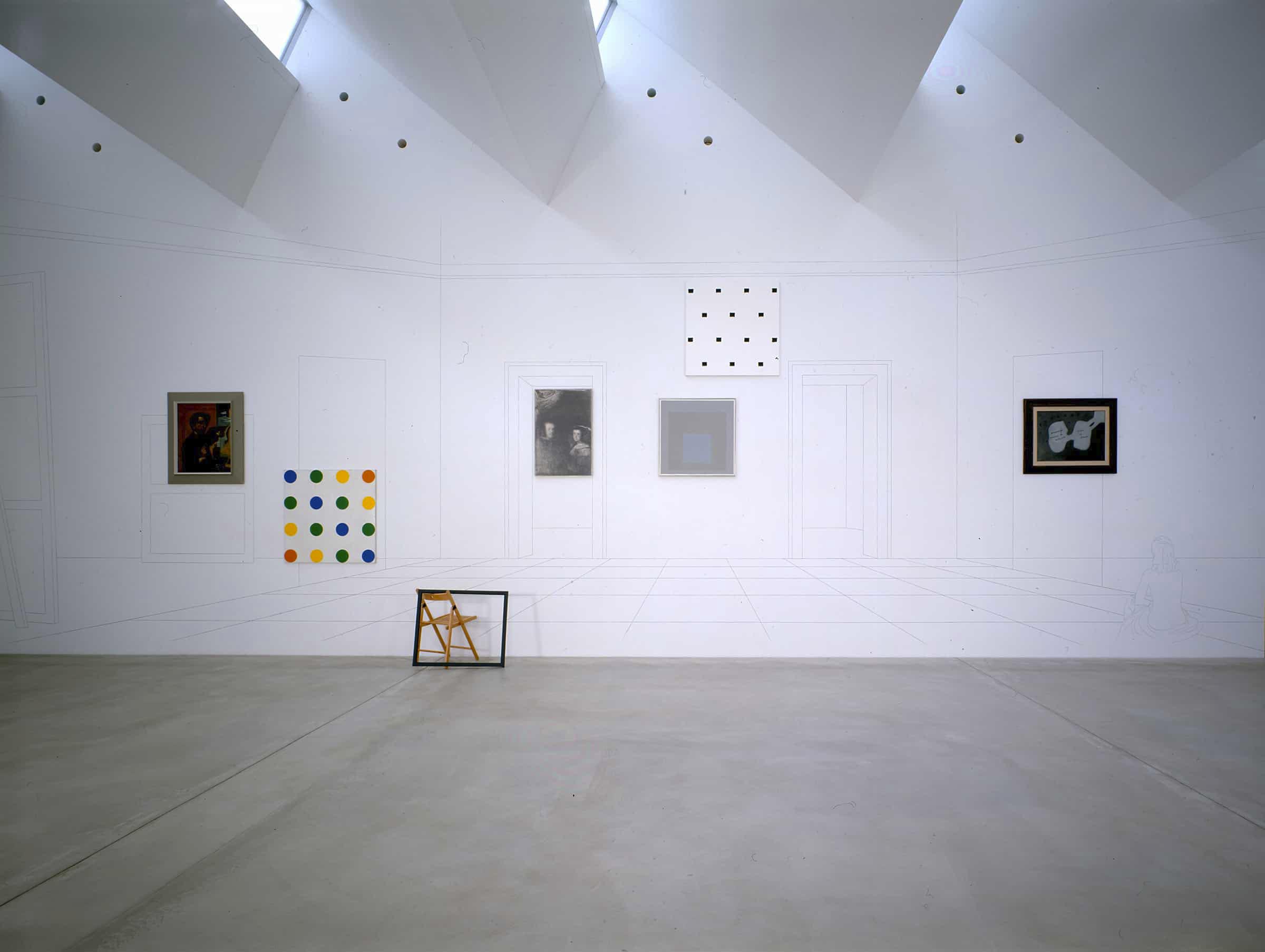
Frame, chair, paintings, pencil on wall
Dismantled work
The perspectival drawing outlined in pencil on the wall represents a room with two doors on the back wall overlooking another room, while on the shorter sides a linear rectangle recalls two other doors. Furthermore, two paintings are drawn to the left: one is propped up against the wall, the other, at the edge of the drawing, recalls the overturning of Diego Velázquez’s large-scale painting Las Meninas. Outlined at the far right is the profile of a female viewer, seen from behind and seated on the floor (the figure is taken from a painting by Salvador Dalì). The drawing on the wall includes several paintings, selected from the permanent collection of the Kunstmuseum Winterthur, where the work was presented. Located in the area corresponding to the left door – and in the perspectival axis of the large verso of the canvas of Las Meninas – is L’ultimo quadro di Diego Velázquez (1968, GPO-0155) by Paolini himself. A chair, turned towards the 1968 painting, and a black frame are located in front of the wall.
The title, which cites the year Velázquez’s Las Meninas was made followed by the year of Paolini’s work, encompasses the meaning of the work: the mysterious painting of which, in the 1656 Spanish work, all we see is the back, is conceptually that “undated” and still unknown painting that in 2005 the alleged author, represented by the chair in front of the wall, seeks to identify on the horizon line of his field of vision, crowded by his own works and those of others (the room that is drawn may be understood here as the artist’s studio). In a broader sense, the “undated” work evoked in the title is the one that – from Velázquez’s masterpiece and all the way to the present – is forever in search of its own identity: the Painting without a face (or with an endless number of faces) that, from scratch, Paolini always calls into play in his own work.
The iconographic theme harkens back to an idea that was developed in 1999 in the work on paper called 1656-1999 (Da e per M. F. d’A.), dedicated to the art historian Maurizio Fagiolo dell’Arco (GPC-0943).
• Salvador Dalí, Ma femme nue regardant son propre corps devenir marche, trois vertèbres d’une colonne, ciel et architecture, 1945, oil on wood, 61 x 52 cm, private collection.
• Diego Velázquez, Las Meninas, 1656, oil on canvas, 318 x 276 cm, Museo del Prado, Madrid.
Works from the collection of the Kunstmuseum Winterthur, from left to right:
• Giorgio de Chirico, Autoritratto, 1924.
• François Morellet, Bleu, vert, jaune, orange sur blanc, 1954, oil on wood, 100 x 100 cm.
• Joseph Albers, Iridescent (Study for: Homage to the Square), 1965.
• Niele Toroni, Mètre carré étalon, 1990.
• René Magritte, Le monde perdu, 1928, oil on canvas, 54.5 x 73.5 cm.
| 2005 | Winterthur, Kunstmuseum Winterthur, Giulio Paolini. Esposizione universale, 23 April - 24 June, cited in the checklist of exhibited works no. 8 p. 86, col. repr. n. pag. (exhibition view), referred to in the text by D. Schwarz pp. 20-22. |

