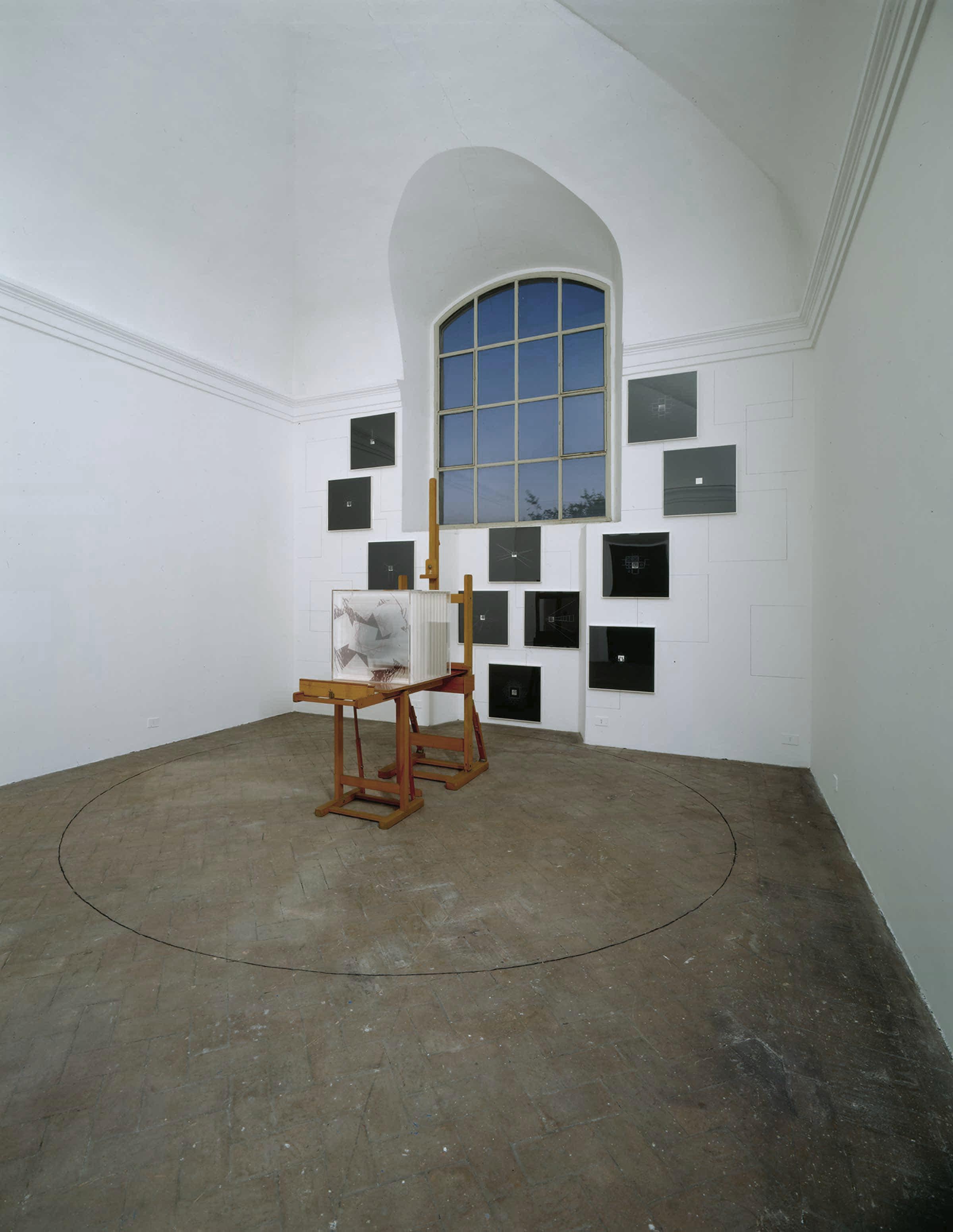
Quadrante, 2002
GPO-0869
Quadrant
Photographic negatives, white pencil and red pencil on black passepartouts framed in plexiglas cases, white passepartouts and red ink on photographic reproductions printed on acetate framed in plexiglas cases, easel, charcoal on floor, pencil on wall
Twenty-four parts 60 x 60 cm each, overall dimensions variable
Dismantled work
The work that was conceived for the solo show at the Atelier del Bosco at Villa Medici in Rome – where it occupied the area facing the entrance, including the window frame featuring square modules – comprises twenty-four plexiglas cases, identical in size to the modular units of the window. Twelve cases are installed to the sides of the window frame, arranged in a circle evoking the face of a clock, while the other twelve are lined up in close succession on an easel situated in line with the window. The elements on the wall overlap a drawn pattern of staggered squares, developed over the entire extent of the wall; the outermost squares are open, thus suggesting a potentially unlimited continuity. The easel is contained inside the circle made in charcoal on the floor, reflecting the circularity of the ensemble of cases hanging on the wall.
The two groups of cases are distinguished by their respective contents. The twelve cases on the wall enclose the photographic negative of a work by the artist previously exhibited in Rome, framed by a wide black passepartout, on which a drawing in white or red pencil extends the vanishing lines or the structural organization of the work reproduced in the negative.1 The twelve cases placed close together one on top of the other on the easel contain a collage of reproductions on acetate of “drawings” (marks traced freehand, squares outlined in red ink, white squares organized in various ways), framed by a white passepartout that increases in size so that the ensemble generates a sort of telescope effect (in the first element in the sequence, visible in its entirety, the passepartout is missing; in the second one, the element is minimal in size, but then grows in the elements that follow, until it occupies almost the entire case, with the window reduced to a small cut).
The meaning of the work is hidden in the relationship between the two complementary groups of cases, that is, between the echoes of the past evoked in the testimonies of previous works in the elements hanging on the wall, and the clues of a future announced in transparency on the easel. If the “quadrant” of dark elements – which in turn resemble episodes surfacing from a very wide dimension, suggested by the pattern of squares drawn on the wall – reveals the impenetrable traces of a time that has already been consumed (hence, the clock motif), the series of light-hued elements suggests an unfinished perspective, turned towards a horizon that is still vague (hence, the image of the telescope). Between the anthology of “paintings” belonging to the past and the search for a “painting” that is still outlined is a vision awaiting definition: a path that is ongoing, a suspended circularity, fleeting like the sky beyond the exhibition space.
1 The twelve negatives reproduce the following works (in parenthesis is the exhibition site that hosted the work in Rome and the year of the exhibition): Senza titolo, 1964 (GPO-0052, Galleria La Salita, 1964); Una copia della luce, 1969 (GPO-0175, Studio La Tartaruga, 1969); La Doublure, 1972-73 (GPO-0246, Galleria L’Attico 1973); Mimesi, 1975 (GPO-0283, Galleria D’Alessandro/Ferranti, 1975); Annali 1961-1976, 1977 (GPO-0370, Galleria Ugo Ferranti, 1977); Del bello intelligibile, 1978 (print edition, Istituto Nazionale per la Grafica, 1980); Early Dynastic (IV), 1978 (GPO-0399, Studio d’arte contemporanea Pino Casagrande, 2001); Qualcuno o qualcosa, 1987 (GPO-0587, Galleria Mario Pieroni, 1987); Ennesima, 1975-88 (GPO-0625, Galleria Nazionale d’Arte Moderna, 1988-89); Contemplator enim, 1991 (GPO-0683, Galleria dell’Oca, 1991); Dilemma, 1995 (GPO-0747, Galleria Gian Enzo Sperone, 1995); Villa Romana, 1996 (GPO-0775, Accademia di Francia, Villa Medici, 1996). In arranging the twelve cases on the wall, the works in question appear clockwise and in chronological order, starting from the first case at the top right.
| 2002 | Rome, French Academy, Atelier del Bosco di Villa Medici, Giulio Paolini. Quadrante, 5 June - 20 August, not repr., references in the text by D. Lancioni, pp. 63, 66-75. |
| • | G. Paolini, Quadrante. Viaggio intorno a un’idea di esposizione (Rome: Edizioni dell’Oca, 2002), pp. 7-11. |
| • | G. Paolini in the interview with E. Clausen, “La vocazione teatrale dell’opera d’arte”, in art’o 12 (Bologna), Autumn, 2002, pp. 38-39. |
| • | “Atelier del Bosco. A cura di Zerynthia”, in Tutto normale, edited by L. Pratesi and J. Sans, exhibition catalogue, Rome, Villa Medici, French Academy, 2002, pp. 204-207 (entry by L. Pratesi, in French, Italian and English), col. repr. pp. 208-209. |
| • | L. Conte, “Date e luoghi del grand tour: Giulio Paolini a Roma”, in Risonanze #2. Giulio Paolini & Fabio Vacchi, exhibition catalogue, Rome, Spazio Risonanze, Auditorium Parco della Musica (Cinisello Balsamo: Silvana Editoriale, 2008), p. 164, not repr. |
| • | D. Lancioni, “Un enigma in prospettiva”, in Giulio Paolini. Gli uni e gli altri. L'enigma dell'ora, exhibition catalogue, Rome, Palazzo delle Esposizioni (Milan: Skira editore, 2010), pp. 19-20, col. repr. p. 20. |
| • | Il libro di Zerynthia, edited by Zerynthia Associazione per l’Arte Contemporanea (Spoltore: Di Paolo Edizioni, 2020), repr. p. 322. |
| • | Claudio Abate. Un progetto di Germano Celant (Cinisello Balsamo: Silvana Editoriale, 2023), p. 384 (referred to in the text by I. Bernardi), not repr. |

