Iride, 2025
GPO-1188
Pencil, red pencil and collage on paper, xerox reproduction applied to paper
Nine framed parts 52 x 52 cm each, overall dimensions 160 x 60 cm
Titled, signed, and dated on the verso of the element 4B, centre: “ "Iride" / Giulio Paolini / 2025"
Private collection
The nine framed elements should be arranged in three rows of three elements each, at short intervals from each other, in order to form a square ensemble.
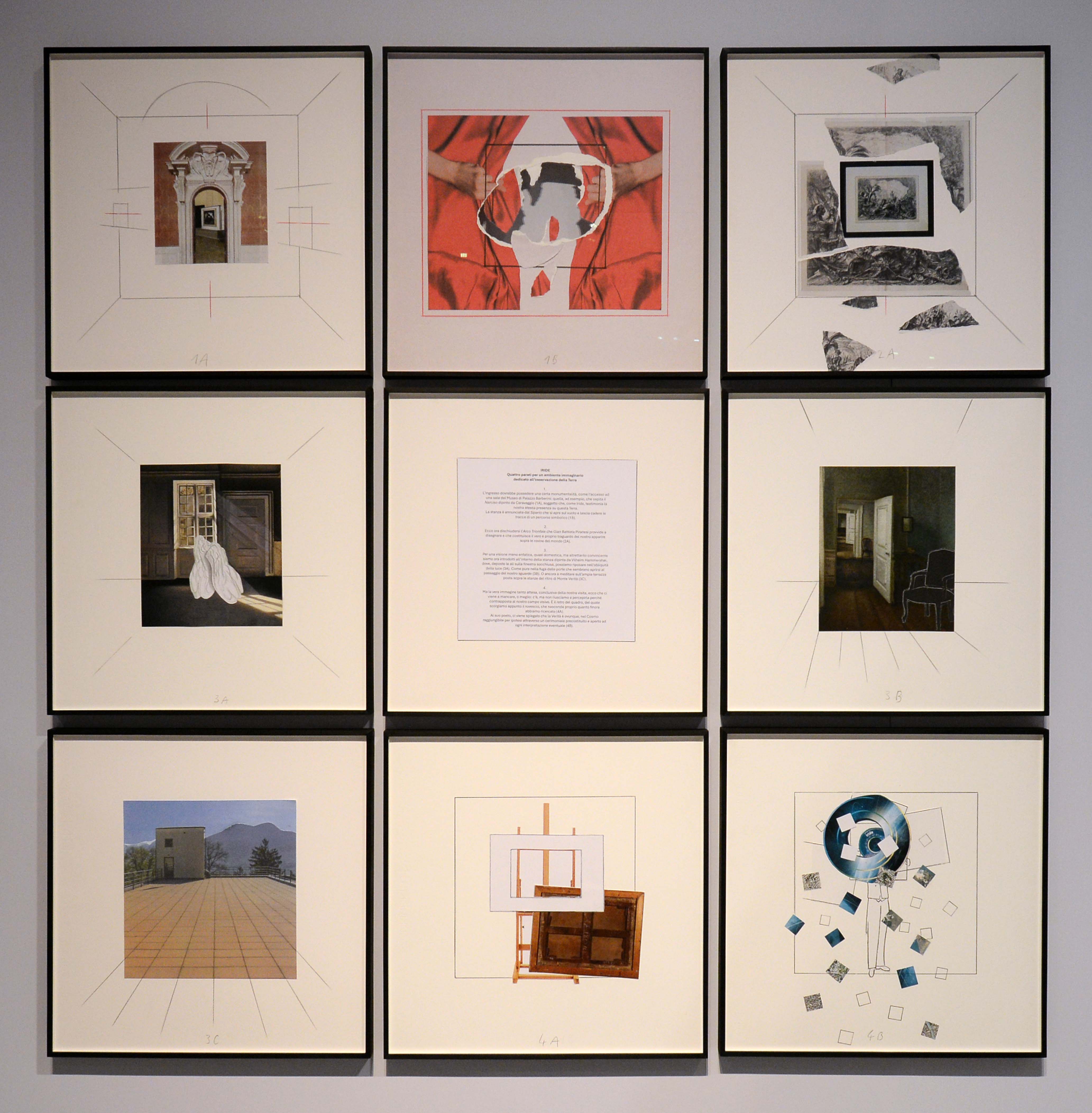
Inspired by the Iride constellation of satellites programme1, this work consists of nine square framed elements placed close together in three rows of three units each. The eight elements featuring an image are arranged in the manner of a frame around a central element that contains a text by the author. The common denominator of the images is either a framing or a perspective evoked by a line drawing. The text has four paragraphs and refers to the images (numbered from 1A, 1B, 2A, 3A, 3B, 3C to 4A and 4B) and states as follows:
IRIDE. Four walls for an imaginary setting dedicated to the observation of the Earth
1. The entrance should have a certain monumentality, akin to the access to a room in the Palazzo Barberini Museum: for instance, the one that hosts Caravaggio’s painting Narcissus (1A), a subject that, like Iride, bears witness to our presence on Earth. The room is announced by the Curtain that opens onto the void and lets fall the traces of a symbolic path (1B).
2. Parting now is the drawing of the Triumphal Arch by Gian Battista Piranesi, which makes up the veritable threshold of our appearing over the ruins of the world (2A).
3. For a less emphatic, almost domestic image, but one that is equally convincing, we are now introduced inside the room painted by Vilhelm Hammershøi, where, having laid our wings on the half-open windows, we can rest in the oblique light (3A). Just as in the series of doors that seem to open as our gaze passes by (3B). Or meditate on the spacious terrace above the rooms of the Monte Verità retreat (3C).
4. But the real image that we have been waiting for, which concludes our visit, is missing, or rather: it is there, but we cannot perceive it because it is opposite our field of vision. It is the back of the painting, that hides what we have been searching for until now (4A). In its place we are told that Truth is everywhere, attainable in the Cosmos by hypothesis by way of a preordained ceremonial open to any eventual interpretation (4B).
The itinerary that from the entrance to a room leads the viewer to the framing of a painting is a description of the work and at the same time of the idea of a painting. From the work we are looking at, our gaze is projected towards an imaginary space, that potentially includes all the paintings possible: on the journey towards an eventual vision, until it disappears into the cosmos, we find nothing definite, but we do intercept elements of images, vanishing points, apparitions, mirages.
1 The work is born out of the RAM radioartemobile initiative, in Rome, which, on the occasion of the Iride project – one of the most important satellite space programs in Europe aimed at observing the Earth from space – invited Felice Levini and Giulio Paolini to create a work related to the themes of space and terrestrial observation. The Iride project, conducted in Italy between 2025 and 2026, is the result of the collaboration between the Italian Government, the European Space Agency, and the Italian Space Agency.
• Element 1A: Caravaggio, Narciso, 1597-99, oil on canvas, 112 x 92 cm, Gallerie Nazionali Barberini Corsini, Rome.
• Element 2A: Giovanni Battista Piranesi, Capriccio Grottesco, 1744-45, etching, 50 x 76 cm (sheet) / 38.8 x 54.5 cm (image), from the series Grotteschi, 1747-49, Istituto Centrale per la Grafica, Rome.
• Element 3A: Vilhelm Hammershøi, Sunbeams or Sunlight. Dust Motes Dancing in the Sunbeams. Strandgade 30, 1900, oil on canvas, 70 x 59 cm, Ordrupgaard, Charlottenlund.
• Element 3B: Vilhelm Hammershøi, Interior, 1914, oil on canvas, 85 x 70.5 cm, Ordrupgaard, Charlottenlund.
• Element 3C: View of Monte Verità, Ascona (Switzerland).
• Element 4B: Logo of the Iride satellite space programme.
| 2025 | Rome, MAXXI Museo nazionale delle arti del XXI secolo, Mediterranea. Visioni di un mare antico e complesso, 17 May - 31 August (work exhibited from 24 June). |

