Era finora, 2021
GPO-1139
What Was Up Until Now
Plaster casts, white plinths, plexiglas cases, pencil and red pencil on wall, xerox reproductions in plexiglas cases
Four halves of two plaster casts h 27 cm each, four plinths 140 x 40 x 20 cm each, four plexiglas cases 40 x 40 x 20 cm each, eight wall cases 40 x 40 x 4 cm each, sixteen squares in pencil on the wall 80 x 80 cm each, overall site-specific dimensions
Fondazione Luigi Rovati, Milan
Acquired in 2022
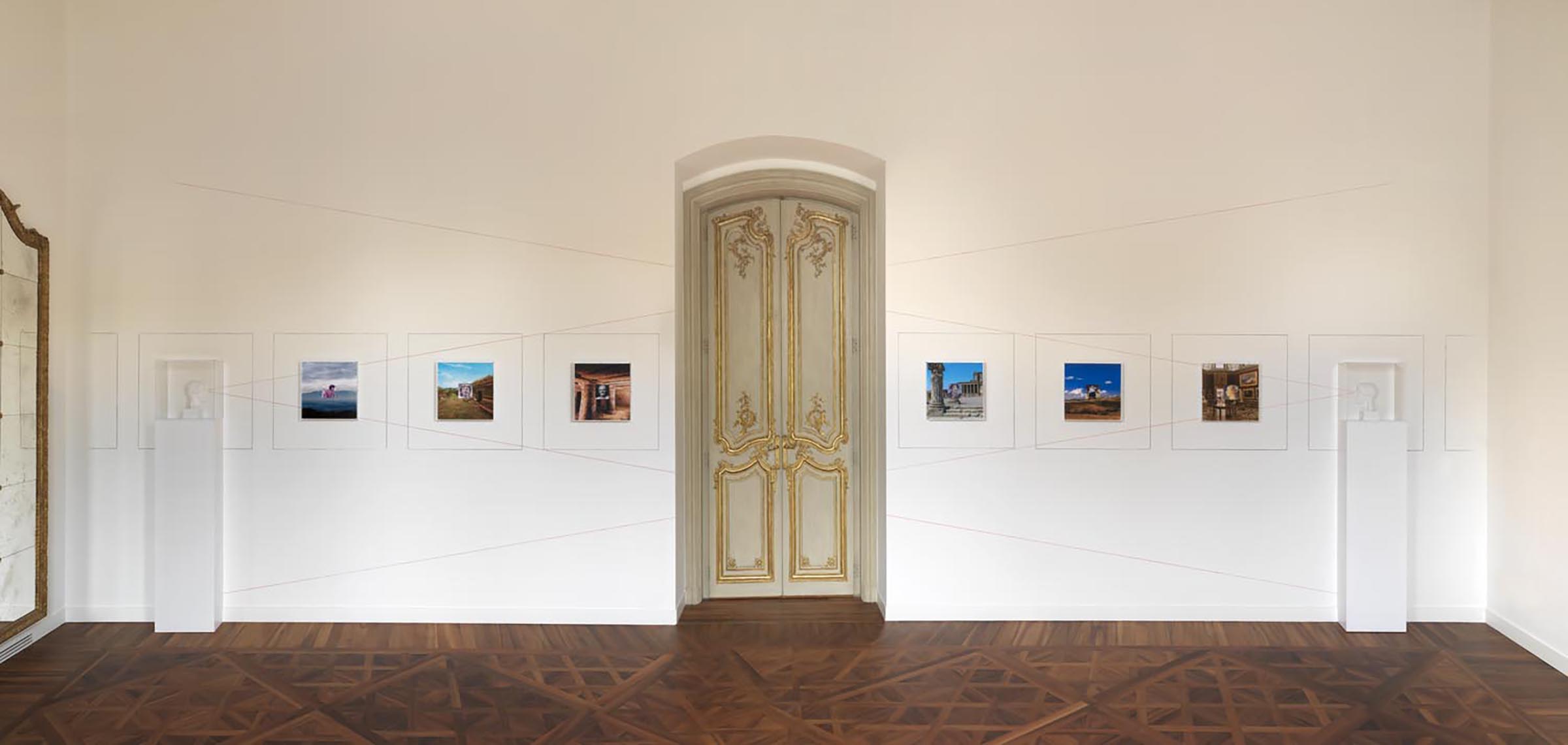
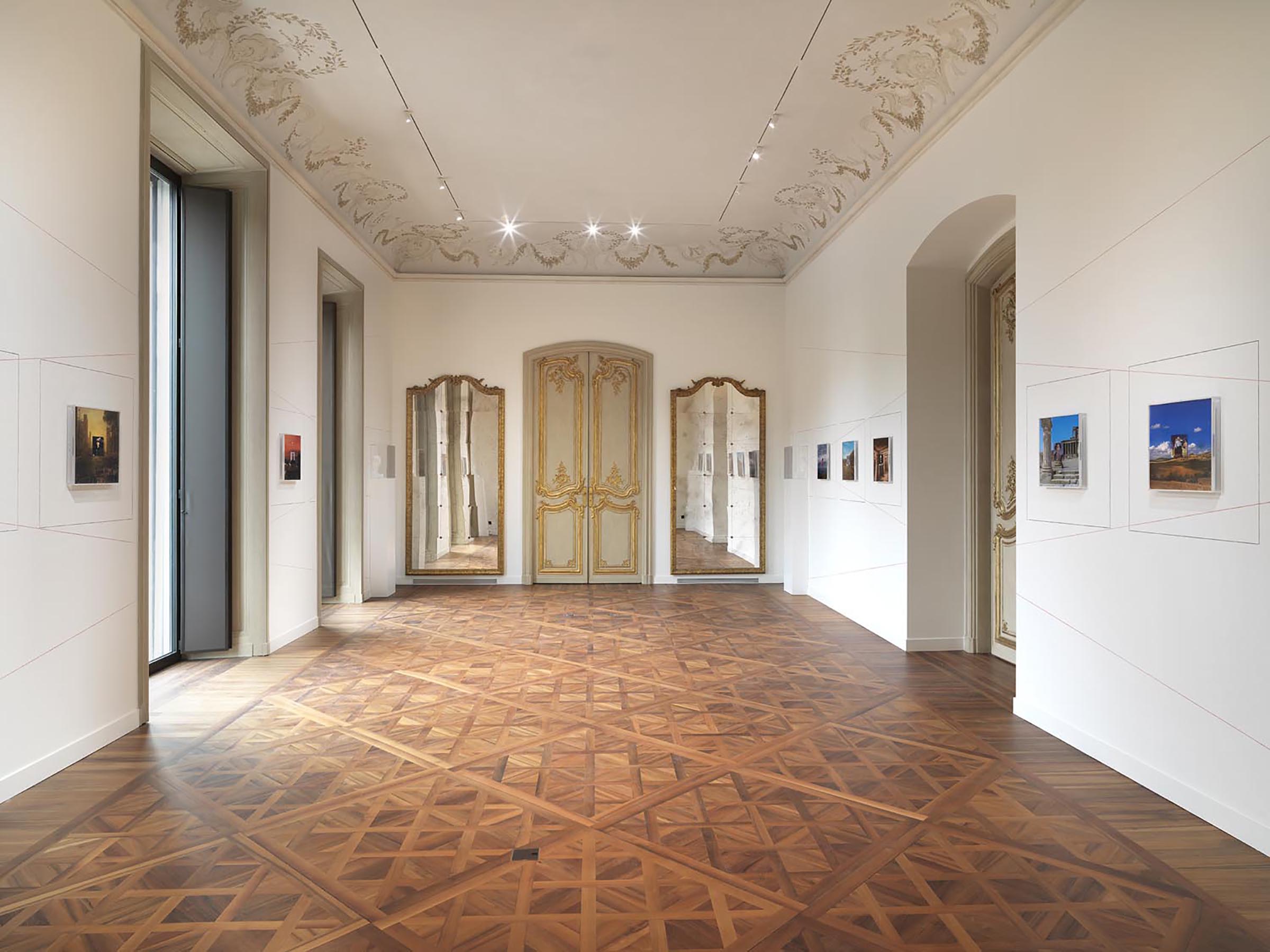
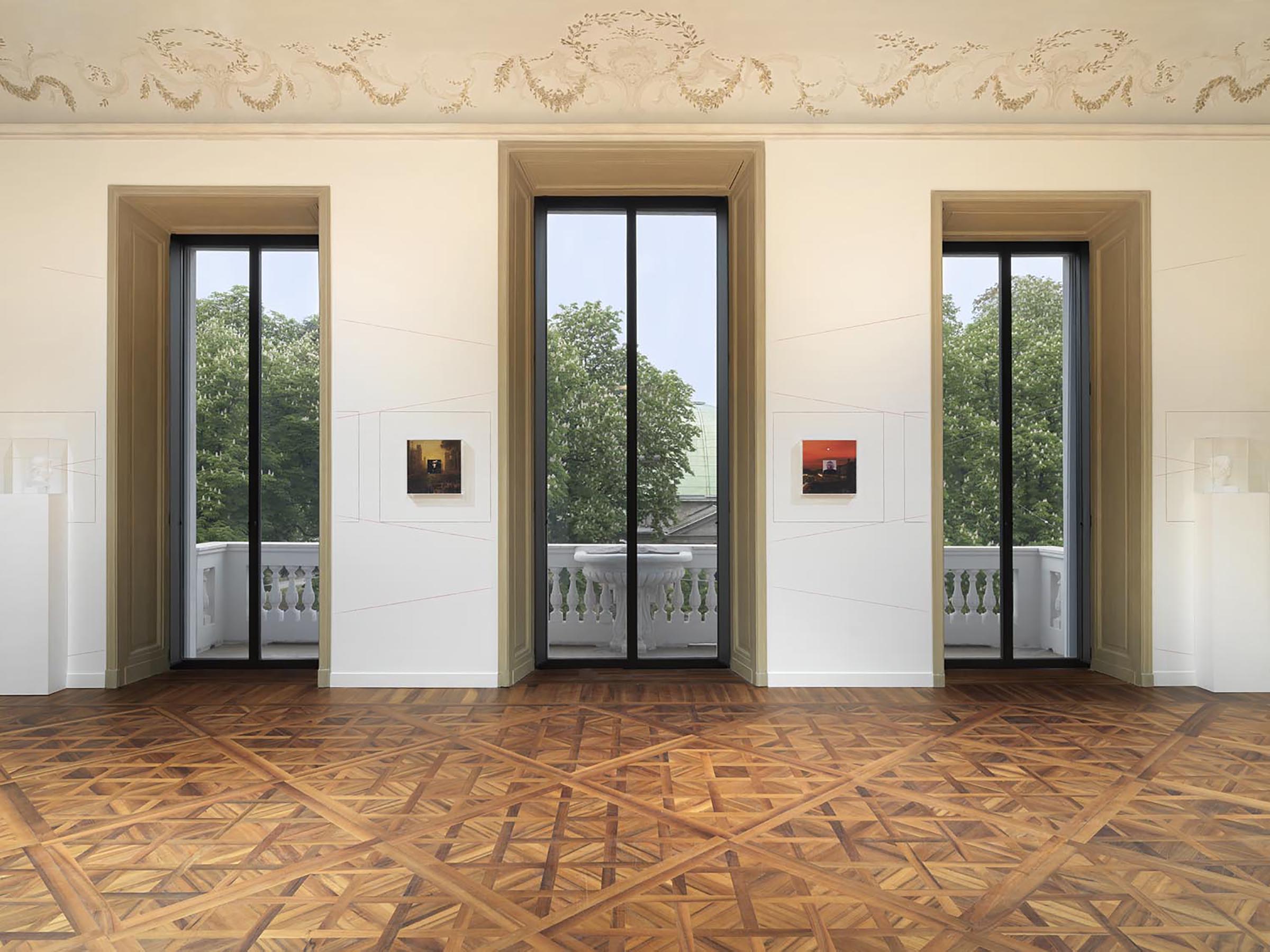
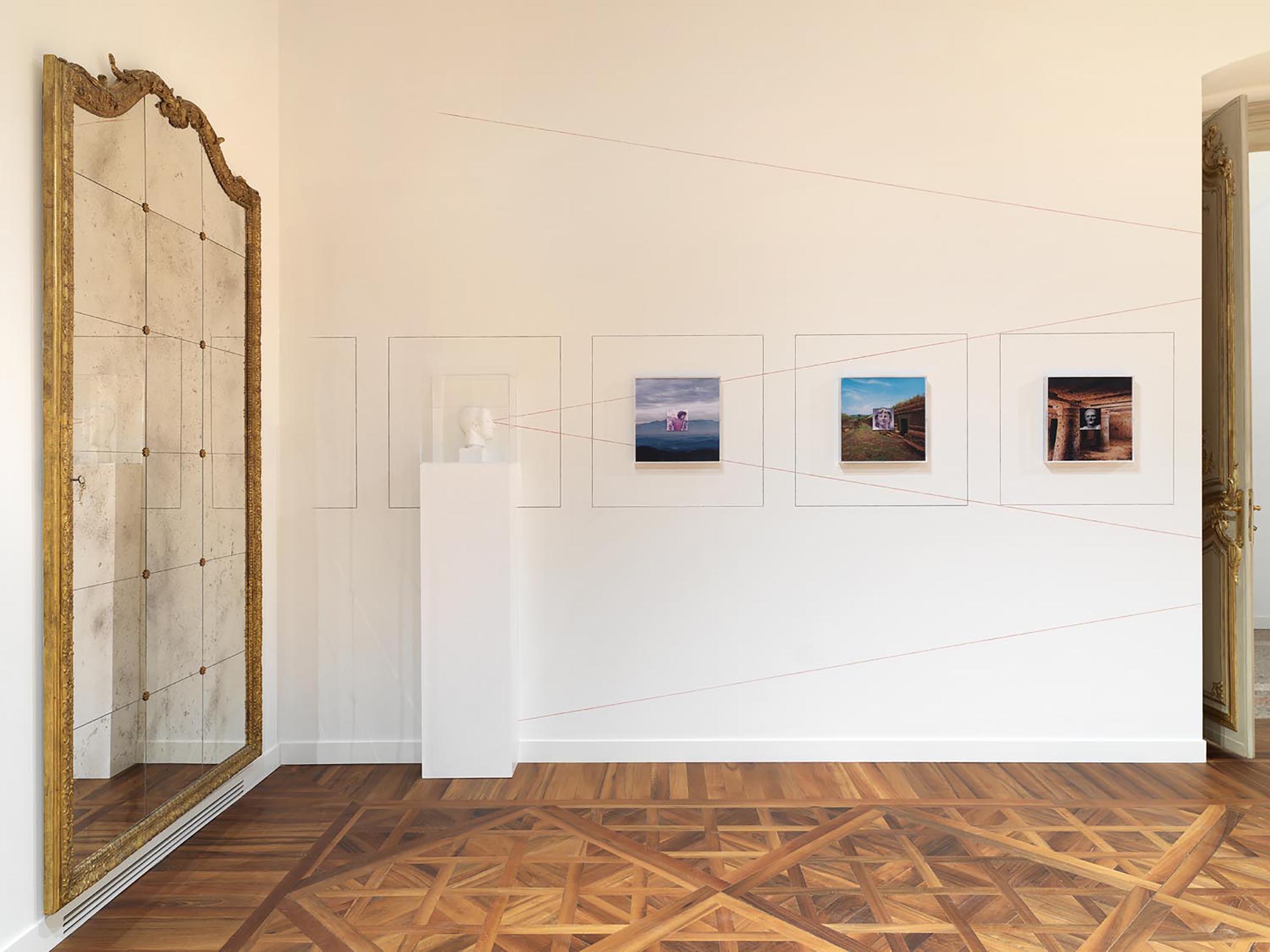
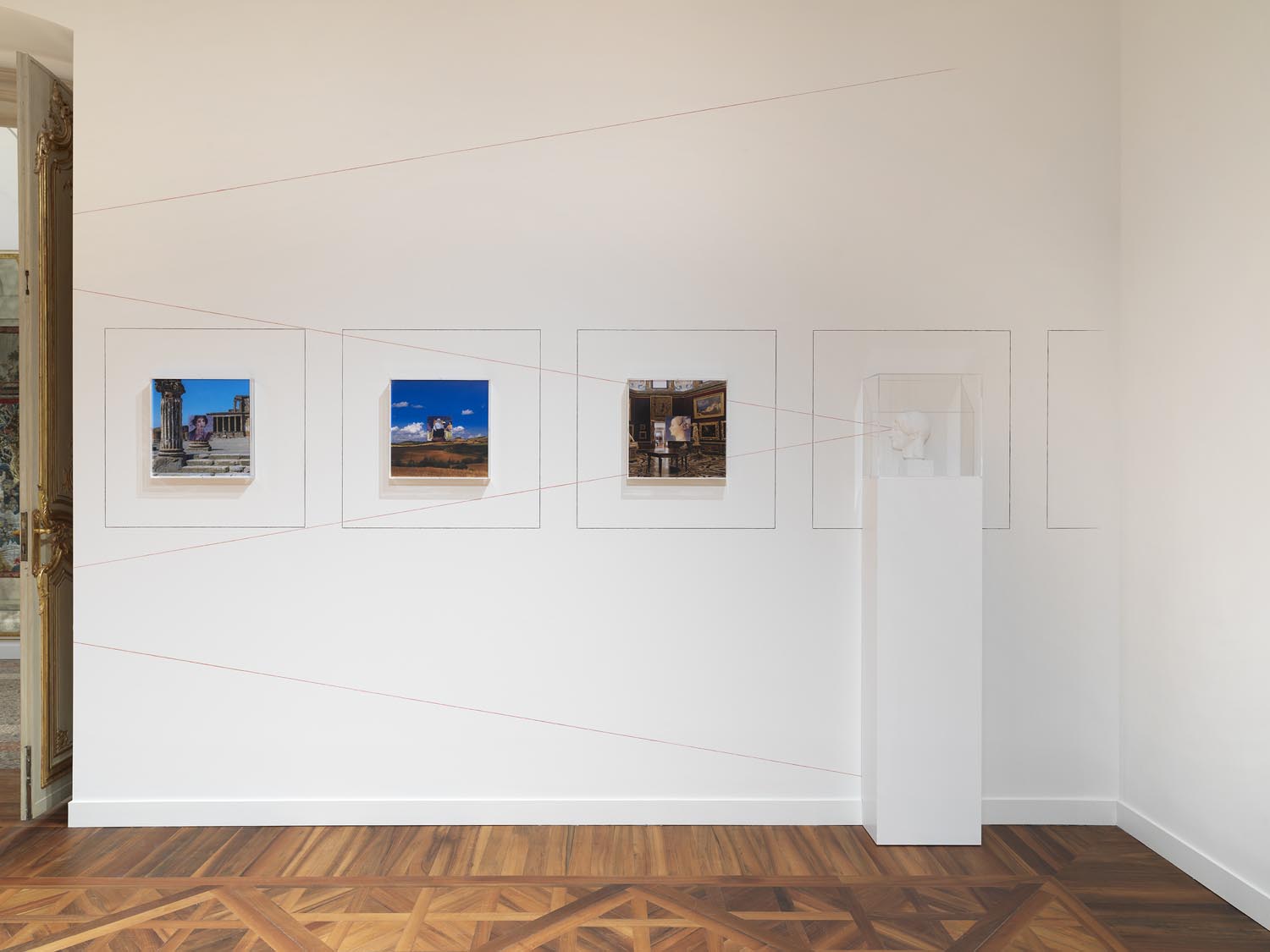
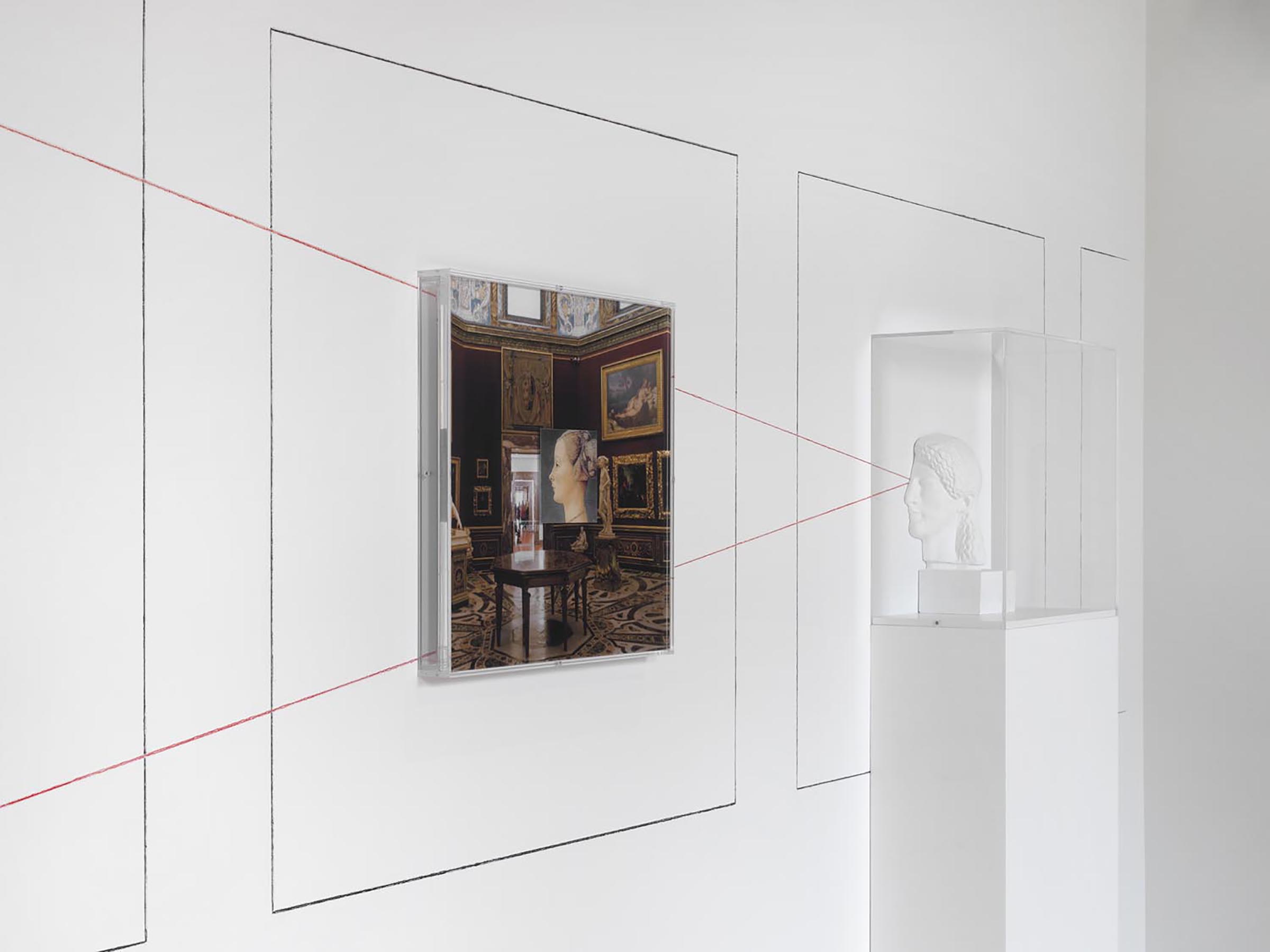
The work consists of two complementary parts, arranged on two opposite walls (referred to as side A and side B). At the far ends of each of the walls are the two halves of a plaster cast of an antique head, each of which set down on a base and facing each other. On side A, the Greek female head represents the classical canon, while on side B the male head evokes the Neoclassical age. On the walls red pencil is used to outline the spot where the two figures’ gaze intersects; the cones of vision embrace a regular sequence of squares drawn in black (six on side A and two on side B), which, in turn, each include an image framed in a plexiglas case. Each case holds the photographic reproduction of an antique landscape or an archaeological site, which acts as a background to a smaller, slightly protruding image representing a figure from the same period (the distance between the two juxtaposed elements alludes to the countless other possible combinations). On side A, the reproductions in the background recall, in chronological succession, places and figures from the Etruscans to the Renaissance, while on side B they provide views and faces from the modern and contemporary ages (the images chosen have no symbolic value, but rather are the details of the history of the images of Western civilization).
Overall, the work underlies a path from antiquity to the present time, from what has been up until now, as the title suggests, towards what is still unknown: in the sequence of squares drawn on the wall, the ones at the far ends of the “frieze” are open, suggesting their limitless continuation. The present – the here and now we find ourselves in – is a moment of suspension between a past that has already been consumed and a future that is as yet unknown. “The work alludes not only to the relativity of the two opposite poles, but also, by extension, to the potential infinity that these same or other possible images have to fulfil the continuity of Beauty, of a story that we certainly cannot contemplate in its entirety, but that we can presume completely”1, the artist says.
Broadly speaking, the gaze that crosses a flow of images is that of the artist who thinks back to a work that is yet to be made, for a continuity with neither a beginning nor an end. For the artist, looking means imagining a work: seeing it in perspective, crossing a historical and temporal dimension, in order to inscribe echoes, memories, visual traces in the space of the representation, determined by the edges of a canvas, a sheet, a wall, or a room, and seen as a universal container of every possible image.
1 G. Paolini in Giulio Paolini. Era finora (Milan: Edizioni Fondazione Luigi Rovati and Johan & Levi editore, 2022), p. 45.
Side A
• Plaster cast: head of Kore, c. 500-490 BC, terracotta, Museo Archeologico Regionale, Agrigento.
• First element, central image: Tomb of the Triclinium, Necropolis of Monterozzi, Tarquinia; background image: view of the Tuscia.
• Second element, central image: head of a youth, 3rd-2nd century BC, terracotta, The Metropolitan Museum of Art, New York; background image: view of the necropolis of Cerveteri.
• Third element, central image: sarcophagus of Laris Pulenas, also known as sarcophagus of the Magistrate, early 2nd century BC, nenfro, Museo Archeologico Nazionale di Tarquinia, Tarquinia; background image: Atrium of the Moretti Tumulus, 6th century BC, Cerveteri.
• Fourth element, central image: Young woman with wax tablets and stylus, also know as Saffo, 55-79 AD, fresco, Museo Archeologico Nazionale, Naples; background image: excavations of Pompeii.
• Fifth element, central image: Benvenuto di Giovanni, Il Buon Governo nell’ufficio della Gabella, 1474, tempera on wood, 53 x 33.5 cm, Museo delle Biccherne, Archivio di Stato, Siena; background image: Tuscan landscape.
• Sixth element, central image: Piero del Pollaiolo, Ritratto di giovane dama, 1470-72, mixed media on wood, 45.5 x 32.7 cm, Museo Poldi Pezzoli, Milan; background image: view of the Tribuna of the Uffizi, Florence.
Side B
• Plaster cast: Antonio Canova, head of Paride, marble, 1807-1812, The State Hermitage Museum, St. Petersburg.
• First element, central image: Joshua Reynolds, Self-Portrait, 1747-48, oil on canvas, 63 x 74 cm, National Portrait Gallery, London; background image: Claude Lorrain, Embarquement de Sainte Paula Romana à Ostia, c. 1637-39, oil on canvas, 211 x 145 cm, Prado Museum, Madrid.
• Second element, central image: portrait of Giovanna Forlanelli, President of the Fondazione Luigi Rovati, Milan; background image: view of Piazza Vittorio Veneto, Turin.
| • | Giulio Paolini. Era finora (Milan: Edizioni Fondazione Luigi Rovati and Johan & Levi editore, 2022); monograph on the work. |
| • | Fondazione Luigi Rovati (Milan: Johan & Levi Editore, 2022), pp. 23, 26, [77], 123, col. repr. pp. [78-79] (installation view at Fondazione Luigi Rovati, Milan), 124-125 (detail). |

