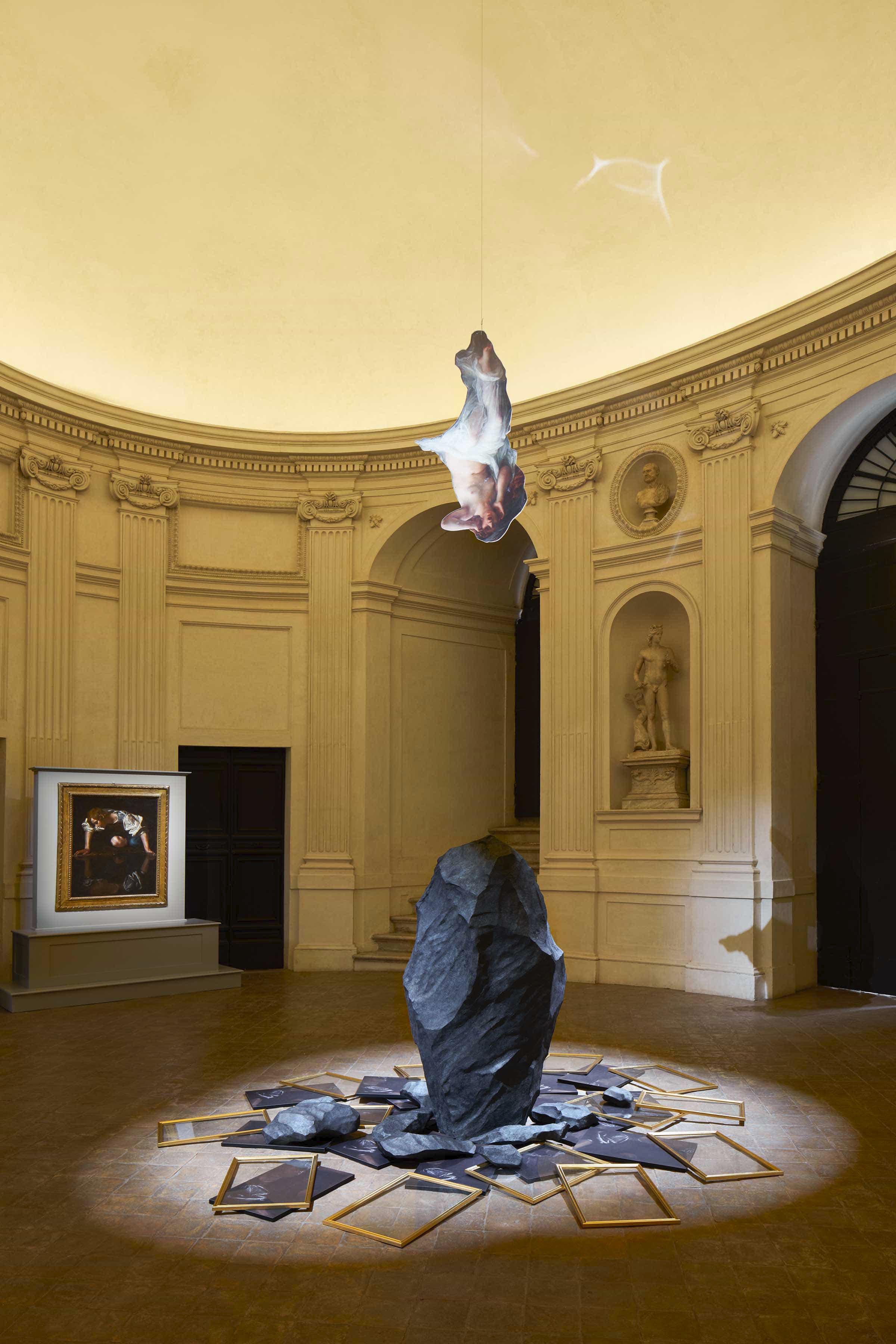
Eco nel vuoto, 2018
GPO-1066
Echo in the Void
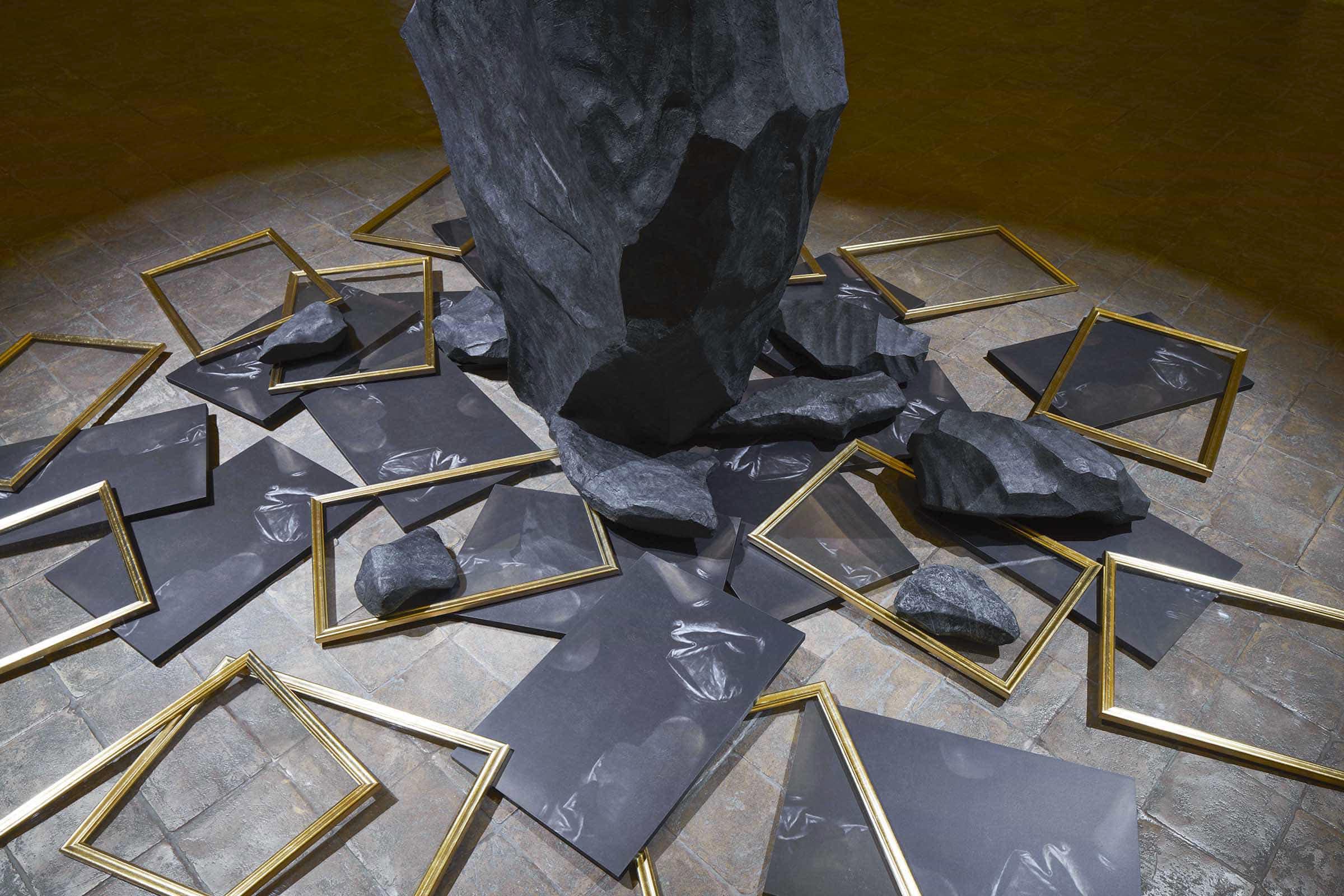
Photo prints mounted between plexiglas shapes, rock and fragments of artificial stone, photographic panels, gilt frames, steel cable
Two photo prints 131.5 x 62 cm each, rock 173 x 94 x 68 cm, fifteen panels and fifteen frames 40 x 60 cm each, overall dimensions variable
Dismantled work
Eco in the Void has been executed for a group show at the Gallerie Nazionali di Arte Antica in Palazzo Barberini in Rom, where it was installed in the Sala Ovale right opposite Caravaggio's Narcissus (1597-99). The photographic shape, turned upside down and hung from the ceiling, is a reproduction of the nymph Echo (after a painting by Alexandre Cabanel), while on the ground an artificial rock stands at the centre of an explosion of details borrowed from Caravaggio's Narcissus, scattered amidst golden frames and fragments of artificial stone.
The work harks back to the tragic fates of Echo and Narcissus, as told in Greek mythology. According to the myth, Echo, hopelessly in love with Narcissus, dies consumed by her unrequited love and is turned to stone, while Narcissus, infatuated with his own beauty reflected in the water, dies in the attempt to touch it. On this is based the association between the nymph and the rock, and Narcissus and the pool of water, evoked by the mounting of frames and photographic details of the lower half of Caravaggio's Narcissus.
Broadly speaking, the work combines allusions to Classical mythology with ones to the artist's personal "mythology". The fates of the two protagonists overlap that of the Artist, who is constantly seeking Beauty, though fully aware of the vanity of his desire. Paolini has been staging this myth repeatedly since the Fall of Icarus (1981). The golden frames represent the ideal painting, always invoked from the outset, but time and time again missing – inaccessible, unattainable, impossible. The dimensions of the frames and photographic panels, 40 x 60 cm, are the same as the ones for Geometric Drawing (1960), the origin of Paolini's research and the conceptual source of his poetics; multiplication and dissemination lose the One – the Absolute, the model – in the multiple and in the fragmentation.
• Alexandre Cabanel, Écho, 1874, oil on canvas, 97.8 x 66.7 cm, The Metropolitan Museum of Art, New York.
• Caravaggio, Narciso, 1597-99, oil on canvas, 112 x 92 cm, Gallerie Nazionali Barberini Corsini, Rome.
| 2018 | Rome, Gallerie Nazionali di Arte Antica Palazzo Barberini, Eco e Narciso. Ritratto e autoritratto nelle collezioni del MAXXI e delle Gallerie Nazionali Barberini Corsini, 18 May - 28 October, col. repr. pp. 32, 34-35, 38-39, 41, 43 (exhibition views), entry by E. Farina p. 43, referred to in the conversation between F. Gennari Santori and B. Pietromarchi pp. 33, 36. |
| • | L. Corrain, M. Vannoni, “L’ellissi riflessa. Le fatali attrazioni nel vuoto di Eco e Narciso”, in Antinomie, collective blog, 21 March 2021, n. pag., col. repr. |
| • | Anacronie. Leggibilità tra passato e presente nel display delle arti, edited by L. Corrain (Bologna: Bononia University Press, 2021), pp. 9, 139-140, 145-158, repr. pp. 146, 149, 152 and col. repr. on cover. |
| • | L. Corrain, Il velo dell’arte. Una rete di immagini tra passato e contemporaneità (Florence: La casa Usher, 2022), pp. 223-224, 226-230, 236, col. repr. n. XXXII (exhibition view Rome 2018), repr. pp. 227, 229, 230 (detail). |
| • | Ovidio, Le Metamorfosi (Turin: Giulio Einaudi editore, 2022), col. repr. p. 123. |
| • | L. Corrain, “Un dialogo fra il Beato Angelico e Giulio Paolini”, in Actes Sémiotiques 127 (Limoges), biannual online journal, 14 July 2022, p. 31, not repr. |

