Requiem, 2003-04
GPO-0888
Shaped wooden panel, shaped primed canvases, cut-out photo printh, wooden pole, music score paper with autograph inscriptions, black pencil, silvered frame, rolled-up printer’s proof, art portfolio, rectangular wooden panel, magazine racks, sheets of drawing paper and other paper elements, centimetre ruler, lamp, chairs
Shaped panel and canvas 120 x 180 cm each, overall dimensions 210 x 240 x 130 cm
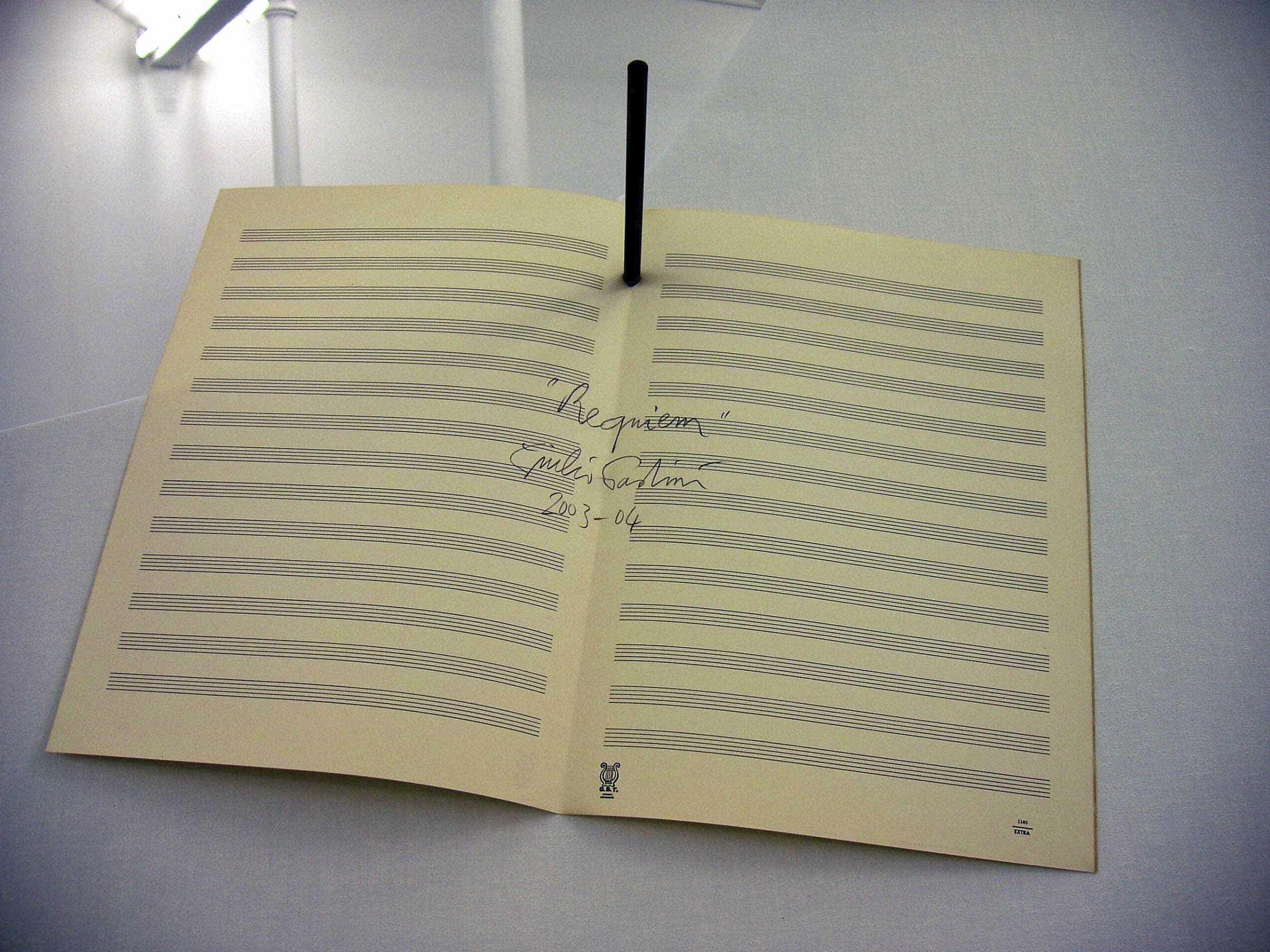
Titled, signed, and dated on the recto of the music score paper, centre:” “Requiem” / Giulio Paolini / 2003-04”
GAM Galleria Civica d'Arte Moderna e Contemporanea, Turin, on loan from Fondazione per l'Arte Moderna e Contemporanea CRT
Acquired in 2005, inventory no. CRT/71
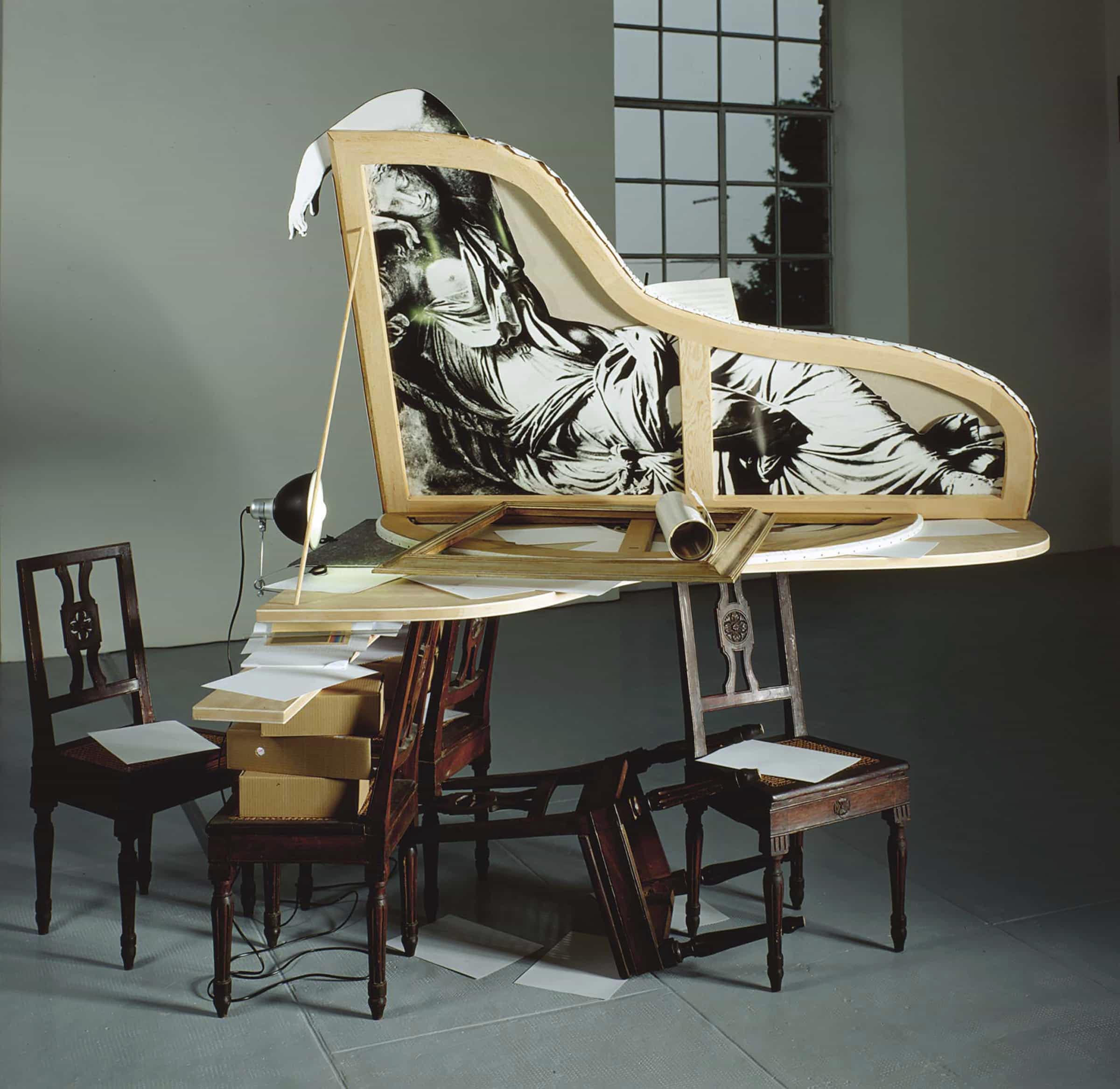
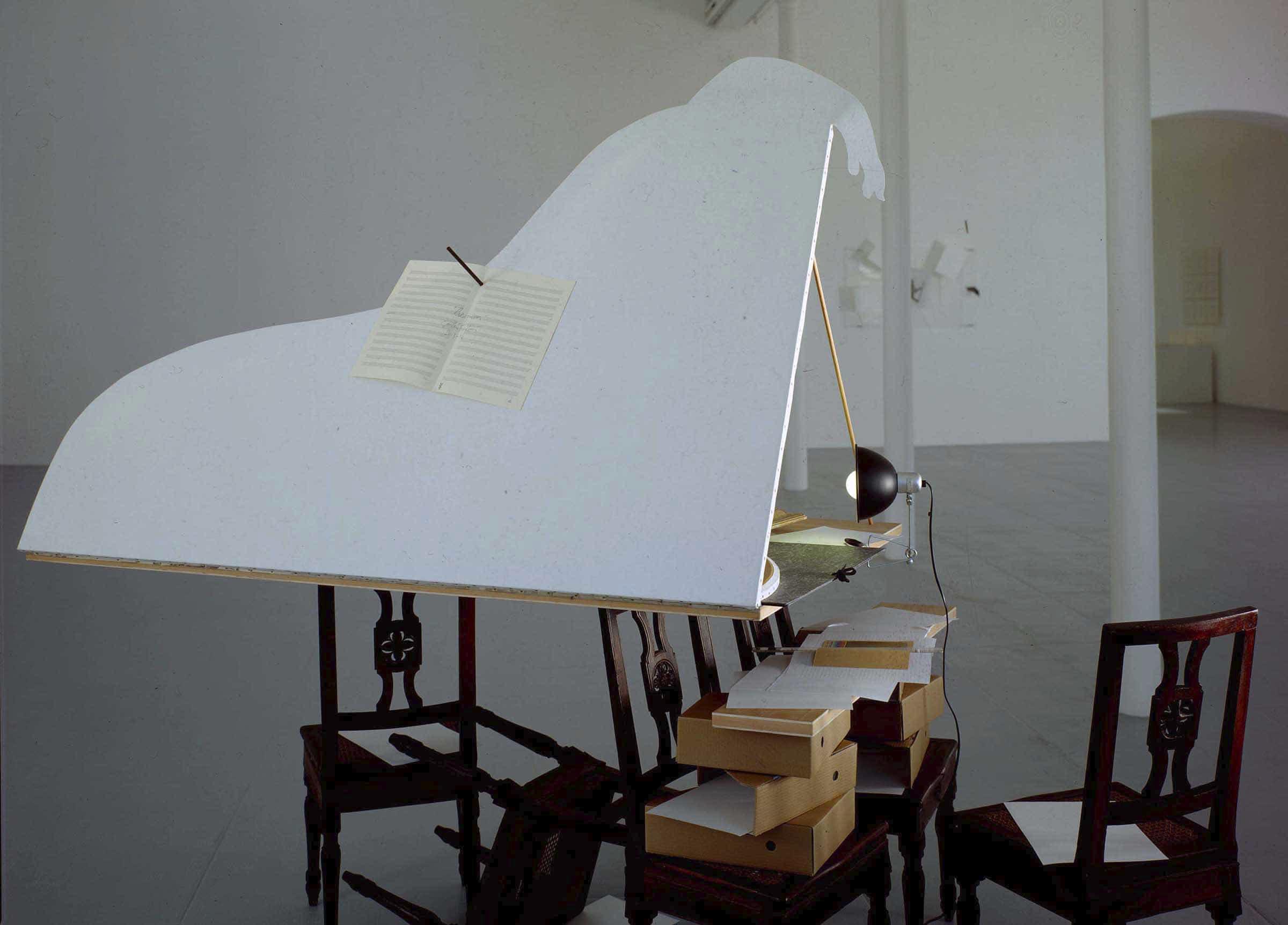
The assemblage of elements in Requiem evokes a grand piano: a shaped wooden panel placed on three chairs represents the sound board, while a large shaped canvas serves as the open lid, upraised by a wooden pole. The keyboard consists of a rectangular panel set upon six magazine racks piled up irregularly on two chairs.
On the recto of the canvas shaped like a lid is a sheet of music score paper pierced by a black pencil and marked in autograph calligraphy with the signature, title, and date of the work. On the verso, under the stretcher bars is a cut-out image of Sleeping Ariadne (the reproduction of the Hellenistic sculpture is reversed with respect to the original). Situated on the surface of the sound board, one atop the other, are a printer’s proof rolled up as though it were a scroll, a silvered frame, and a reversed semicircular canvas, as well as an art folder and several sheets of drawing paper. Four white sheets of paper are freely placed on the “keyboard”, along with, in a central position, a foolscap folio, on which two ochre-coloured cards serve as an open folder holding a sample of twelve coloured cards, arranged in careful succession (the first sheet, which is entirely visible, is golden) and held down by a centimeter ruler. Not far from the keyboard is a chair, while another chair is overturned on the floor in between the chairs supporting the piano (there are other white sheets of paper scattered about on the floor and on the overturned chair). A lit spotlight, clipped on to the shaped panel, illuminates the objects on the sound board.
The figure of Ariadne – in Greek mythology abandoned by her lover Theseus while she was asleep – suggests the “metaphysical” intonation of this silent “piano”: the objects the artist uses to work with have been “abandoned” to themselves, their voices are silent (the frame is empty, the art folder is closed, the sheets are blank, the printer’s proof is rolled up). The pianist seems to have rushed from the scene, leaving behind his empty chair. And it is precisely this absence that emphasizes the “requiem”; the author has moved away from the role he has been assigned – relinquishing his “authorial nature” – to leave the field to the work, the only protagonist, so that it can reveal itself to the gaze that in the distance and in silence awaits it. The “exiled” author simply ascertains his estrangement to the making of the work.
In the artist’s own words: the title, “literally, is the recollection of something that is no longer there, but in this case it is something that isn’t there yet or that can never be there... something we do not succeed in touching".1 Something that remains suspended between the no longer and the not as yet, in the silence of mute echoes and ineffable resonance.
1 G. Paolini in conversation with P.G. Castagnoli, Galleria dell’Oca, Rome, 25 November 2004, published in “Giulio Paolini. Le cose, materia di disegno”, edited by M. D’Alessandro and L. Laureati, in disegno industriale 13 (Rome), 2005, p. 98.
Sleeping Ariadne, 1st-2nd century AD Roman copy of a Hellenistic original, marble, 161 cm, Musei Vaticani, Rome; reproduction from Francis Haskell, Nicholas Penny, Taste and the Antique: The Lure of Classical Sculpture 1500-1900 (New Haven, Connecticut: Yale University Press, 1982), p. 185, fig. 96 (“Cleopatra”).
| 2004 | Torre Pellice, Tucci Russo Studio per l’Arte Contemporanea, Giulio Paolini. Qui e ora, 8 May - 26 September. |
| 2004 | Rome, Galleria dell’Oca, Giulio Paolini. Carte segrete, 5 November 2004 - 10 January 2005. |
| 2006-07 | Turin, Torino Esposizioni, Museo Museo Museo 1998-2006. Otto anni di acquisizioni per le raccolte della GAM, 8 November 2006 - 27 January 2007, col. repr. n. pag. |
| 2011-13 | Turin, GAM Galleria Civica d’Arte Moderna e Contemporanea, Quattro nuove tematiche per le collezioni della GAM, 4 March 2011 - February 2013, [in the volume Collezioni. Volume 3: Allestimento 2011-2013, Turin 2012] cited in the checklist of exhibited works p. 331, col. repr. pp. 212, 224-225 (exhibition view), references in the text by E. Volpato pp. 212-213. |
| 2020-23 | Turin, GAM Galleria Civica d’Arte Moderna e Contemporanea, Il primato dell’opera. Il nuovo allestimento della collezione del Novecento storico, 26 September 2020 - 8 October 2023, no catalogue. |
| • | G. Paolini in conversation with P.G. Castagnoli, Rome, Galleria dell’Oca, 25 November 2004, extract published in M. D’Alessandro, L. Laureati, “Giulio Paolini. Le cose, materia di disegno”, in disegno industriale 13 (Rome), 2005, pp. 101-105. |
| • | M. D’Alessandro, L. Laureati, “Giulio Paolini. Le cose, materia di disegno”, in disegno industriale 13 (Rome), 2005, col. repr. pp. 98, 99 (exhibition view Rome 2004). |
| • | G. Paolini, Quattro passi. Nel museo senza muse (Turin: Giulio Einaudi editore, 2006), repr. p. 127 (exhibition view Rome 2004). |
| • | M. Volpi, “La luminosa bellezza del disegno”, in Risonanze #2. Giulio Paolini & Fabio Vacchi, exhibition catalogue, Rome, Spazio Risonanze, Auditorium Parco della Musica (Cinisello Balsamo: Silvana Editoriale, 2008), p. 38, repr. p. 62 (exhibition view Rome 2004); republished in M. Volpi, L’occhio senza tempo. Saggi di critica e storia dell’arte contemporanea (Rome: Lithos editrice, 2008), p. 256, repr. p. 74, with incorrect indication of the ownership). |
| • | L. Cherubini, “Hic et nunc”, ibid., p. 58. |
| • | Dieci anni di acquisizioni per la GAM di Torino 1998-2008, edited by P.G. Castagnoli and E. Volpato (Turin: Umberto Allemandi & C., 2008), catalogue entry by V. D’Urso p. 513, col. repr. no. 89 (exhibition view Rome 2004), col. repr. n. pag. (exhibition view Turin 2006-07). |
| • | Dieci anni e oltre. La collezione della Fondazione per l'Arte Moderna e Contemporanea – CRT per Torino e il Piemonte, edited by M. Beccaria and E. Volpato (Berlin: Archive Books, 2010), p. 362, col. repr. p. 367 (exhibition view Turin 2006-07). |
| • | A. Bona, “Tormento e follia”, in MAG. Magazine d'arte della GAM 2 (Turin), June-September, 2011, col. repr. p. 11 (exhibition view Turin 2011). |
| • | Collezioni. Volume terzo: Allestimento 2011-2013, edited by D. Eccher (Turin: GAM Galleria Civica d’Arte Moderna e Contemporanea and Umberto Allemandi & C., 2012), pp. 195 (referred to in the text by G. Contessi), 212-213 (referred to in the text by E. Volpato), repr. p. 212, col. repr. pp. 224-225 (exhibition view Turin 2011). |
| • | L. Cherubini, “Amori Loro”, in L’uomo e l’arte, exhibition catalogue, Rome, Erica Ravenna Arte Contemporanea (Rome: Maretti Editore, 2021), p. 20, not repr. |
| • | L. Madaro, “Ordine e rigore nell’archivio di Giulio Paolini”, in Arte 574 (Milan), June, 2021, col. repr. p. 81 (exhibition view Torre Pellice 2004). |
| • | G. Paolini, Eccomi. Qui dove sono (Turin: Fondazione Giulio e Anna Paolini, 2025), col. repr. p. 117 (exhibition view Torre Pellice 2004). |

