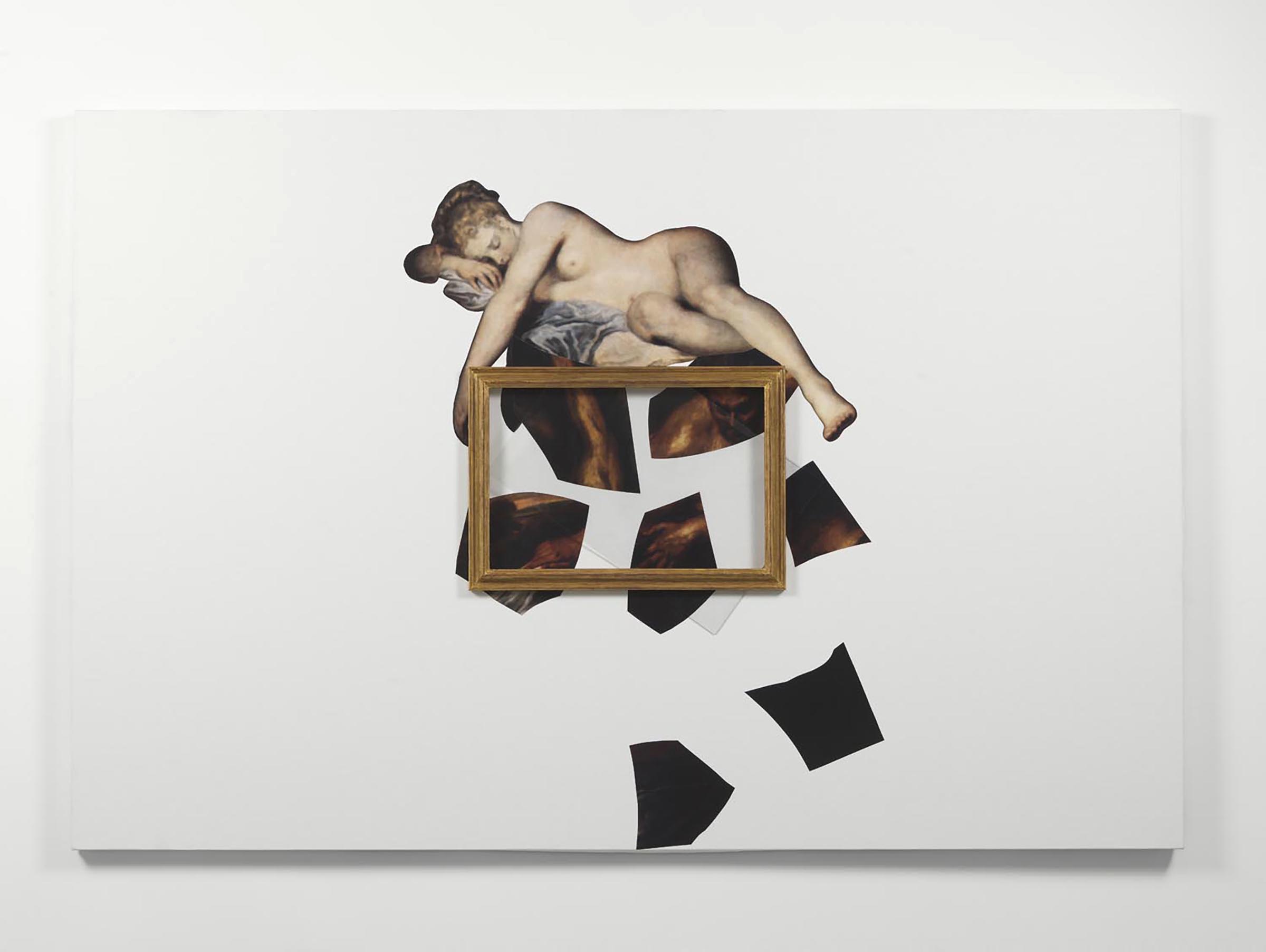
Giove e Antiope, 2016-21
GPO-1116
Jupiter and Antiope
Collage on canvas, gilt frame, plexiglas sheet
Canvas 160 x 240 cm, frame and sheet 40 x 60 cm each
Titled, signed, and dated on the verso, upper stretcher bar, centre: “ “Giove e Antiope” / Giulio Paolini / 2016-21”
Collection of the artist
Lying atop the gilt frame applied to the centre of the canvas is the image of a female nude, while from the void of the frame and from the plexiglas sheet, in a precarious balance, the fragments of the image of a satyr are scattered downwards at random.
As the title indicates, the work refers to the protagonists of the painting, Nymphe et Satire (1715-16, also known as Jupiter et Antiope) by Jean-Antoine Watteau, in which, as Paolini declares, “Jupiter in the shade and in the middle ground discovered Antiope without touching her… It seems there will be no contact in a scene where the light is all that offers the absolute beauty of a body”.1
Just as in Greek mythology Jupiter, disguised as a satyr, desires and seduces Antiope, so the artist attempts to fix Beauty within the limits of a painting. The ideal dimension – which is also underscored by the gilt frame – escapes every attempt at definition, however, as suggested by the sheet that is askew and the fragmented image.
1 G. Paolini in conversation with B. Della Casa, 7 February 2021.
Jean-Antoine Watteau, Nymphe et Satyre, dit parfois Jupiter et Antiope, 1715-16, oil on canvas, 73.5 x 107.5 cm, Musée du Louvre, Paris.
| 2021 | Naples, Alfonso Artiaco, Giulio Paolini. Fuori quadro, 8 March - 1 June. |
| 2023 | Singapore, The Arts House and The Italian Embassy, The Grand Italian Vision: The Farnesina Collection, 7-25 February, touring to: Tokyo, Istituto Italiano di Cultura, 25 March - 7 May; New Delhi, Bikaner House, Centre for Contemporary Art, 26 May - 22 June; Seoul, Space 2, Art Sonje Center, 15 July - 20 August; New York, various venues, 18 September - 27 October, col. repr. p. 155. |

