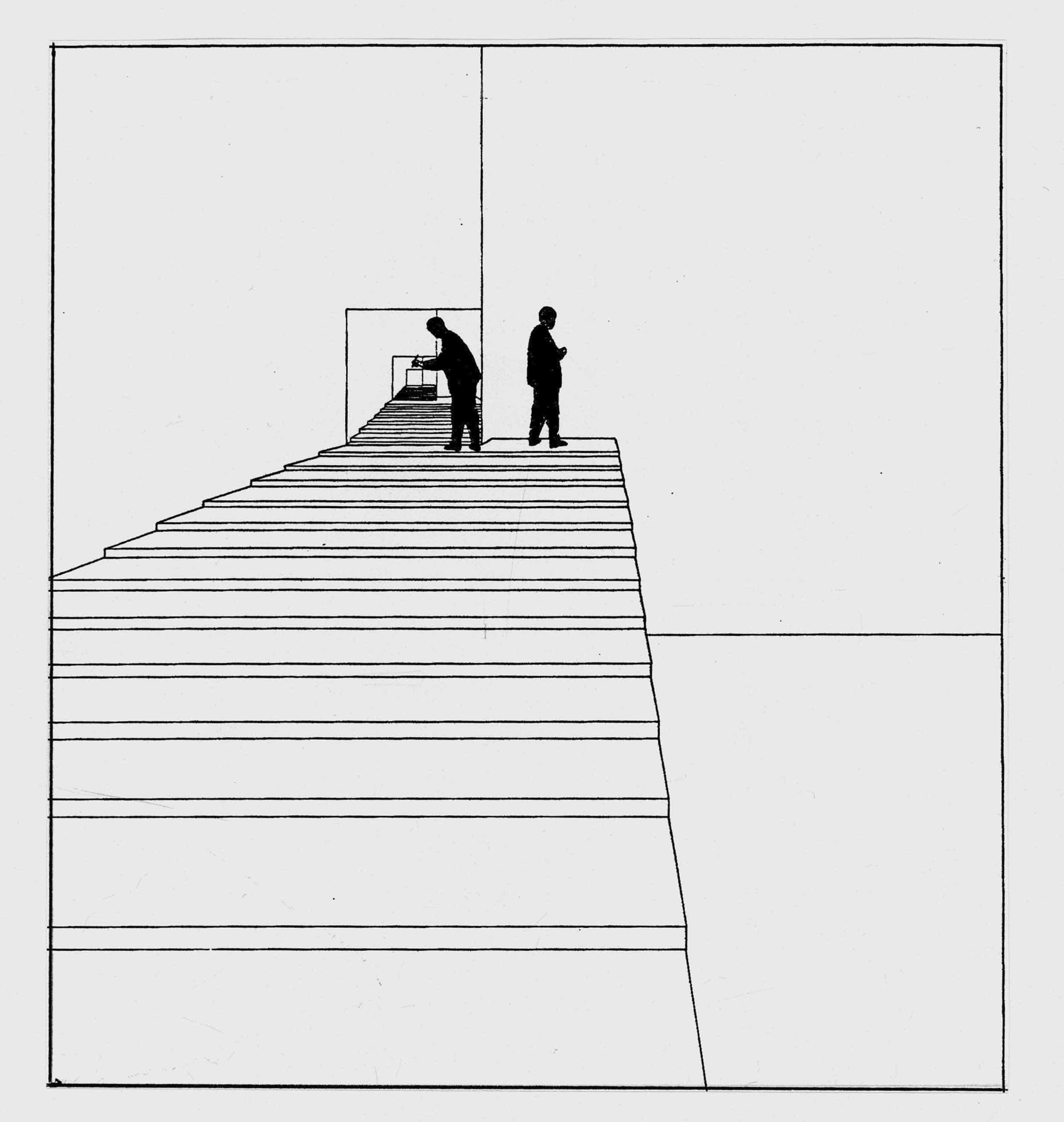
Doppio gioco, 1997
GPO-0791
Double Play
Unrealized project
The first project that was conceived for the entrance stairway of the Neues Museum in Weimar, in view of the opening of the museum in 1998, was later revised and adapted for a stairway outside the Galleria Nazionale d’Arte Moderna in Rome, on the occasion of its restoration and expansion.1 In both cases and for different reasons, the clients decided not to go ahead with the work.
The artist describes the project as follows: “Two male figures (two life-size bronze or marble statues wearing contemporary clothing) stand at the top of an outdoor staircase. Apparently identical in their appearance and pose, like two copies of the same original, they are, however, two different moments of the same figure. The two moments are not – as is usually the case – placed in succession one after the other, hence, they do not observe an order of precedence: they are – in absolute terms – simultaneous; no one – I believe – will ever be able to ascertain which of the two comes before or after the other. The first figure, slightly bent forward, is intent on drawing on a square surface on the vertical plane created by the staircase and the wall. The tip of his pencil touches the centre of the square, which the drawing traced on the surface indicates as being his exact location. The second one, a short distance from the first one and placed at the centre of a square surface equal to the previous one but on a horizontal plane, is instead intent on observing: his gaze is suspended and is lost in the distance. The two figures both gravitate around the same 'game table'. The game can never begin, nor can it end, because one and the other are guests, not hosts, in the same place: the place of the work, that is, the space where the work takes place. The host of the work is the author, who in turn hosts the viewer. To draw, observe. To observe, draw... Inverting the order of the factors the image does not change, the dilemma remains, the Liber Veritatis continues endlessly”.2
1 The Roman initiative involved six architects and six artists (Stefano Arienti, Enzo Cucchi, Nunzio, Giulio Paolini, Paola Pezzi, Marco Tirelli) invited in March 1997 by the Soprintendenza Speciale per l’Arte Contemporanea - Galleria Nazionale d’Arte Moderna to develop guidelines for a project for the valorization and expansion of the museum. The materials sent by the candidates were exhibited at the Galleria Nazionale d’Arte Moderna from 6 May to 1 June 1997. The project was then abandoned in favour of a new architectural competition held in 1999.
2 G. Paolini in Giulio Paolini. Von heute bis gestern / Da oggi a ieri, exhibition catalogue, Graz, Neue Galerie im Landesmuseum Joanneum (Cantz Verlag: Ostfildern-Ruit, 1998), p. 338. The description refers to the Roman variant of the project. In Weimar the two figures were supposed to be at the foot of the staircase and both of them slightly bent over the horizontal planes of the two symmetrical pilasters.
| • | G. Paolini in Giulio Paolini. Von heute bis gestern/Da oggi a ieri (Graz/Ostfildern-Ruit: Neue Galerie im Landesmuseum Joanneum and Cantz Verlag, 1998), p. 338. |
| • | A. Coulange, Giulio Paolini. Carnets de la commande publique (Paris: Éditions du Regard, 1997), repr. p. 70 (Weimar project). |
| • | Giulio Paolini. Von heute bis gestern / Da oggi a ieri, exhibition catalogue, Graz, Neue Galerie im Landesmuseum Joanneum (Ostfildern-Ruit: Cantz Verlag, 1998), repr. p. 338 (Rome project). |
| • | M. Disch, Giulio Paolini. Catalogo ragionato 1960-1999, vol. 2 (Milan: Skira editore, 2008), cat. no. 791 p. 809, col. repr. |
| • | F. Guzzetti, “Spiegelung und ‘Äquivalenz’. Giulio Paolini, Paul Maenz und Gerd de Vries”, in YES TO ALL. Die Schenkung Paul Maenz Gerd de Vries, exhibition catalogue, Berlin, Staatliche Museen zu Berlin – Kupferstichkabinett (Berlin: DCV, 2025), pp. 125-126, not repr. |

